Last Updated: October 8, 2026
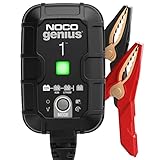
The best car battery chargers for most everyday vehicles are the NOCO Genius1 for a compact all-rounder, the CTEK MXS 5.0 for faster and more capable 12-volt charging, and the Battery Tender Junior for simple long-term maintenance on a healthy battery.
As an Amazon Associate we earn from qualifying purchases at no extra cost to you.



Best car battery chargers at a glance
| Charger | Best for | Output and compatibility | Notable features | Typical market range |
|---|---|---|---|---|
| NOCO Genius1 | Most drivers and small storage spaces | 1A; 6V and 12V lead-acid, AGM, gel and lithium batteries | Automatic charging, repair mode, temperature compensation, spark-proof connections | $30–$50 |
| CTEK MXS 5.0 | Faster charging and regular use | 5A; 12V lead-acid and AGM batteries | Eight-step program, reconditioning mode, temperature-adjusted charging, IP65 enclosure | $90–$130 |
| Battery Tender Junior 12V | Maintaining a parked car or motorcycle | 0.75A; 12V lead-acid, AGM and gel batteries | Automatic float maintenance, fused ring-terminal and alligator-lead options | $30–$45 |
| OptiMate 4 | Seasonal vehicles and battery diagnosis | 1A; 12V lead-acid and AGM batteries | Multi-stage charging, recovery program, dual charging-program versions available | $70–$100 |
Prices are broad market ranges and vary by kit, region and included cable accessories. Check the current manual before connecting any charger to a lithium battery: a charger designed for lead-acid chemistry is not automatically safe for LiFePO4 batteries.
Which charger should you buy?
Choose the NOCO Genius1 for the best general-purpose balance
The Genius1 is a sensible choice for a household vehicle, especially if the charger must fit in a glove box or small toolbox. Its 1-amp output is gentle and appropriate for maintaining a car that sits unused, while its 6V and 12V selection makes it useful for some older vehicles, motorcycles and lawn equipment.
The compromise is speed. A 1-amp charger is primarily a maintenance and overnight-charging tool, not a quick rescue device. It can also take many hours to replenish a heavily discharged car battery. Its automatic program reduces the need to monitor voltage manually, and its recovery mode may help with some sulfated lead-acid batteries, although it cannot restore a battery with a failed cell or severe physical damage.
Choose the CTEK MXS 5.0 when charging speed matters
At 5 amps, the CTEK MXS 5.0 is substantially quicker than 0.75- or 1-amp maintainers. It is a strong fit for a daily driver with a weak battery, a vehicle used occasionally but needing dependable starts, or an owner who wants more controlled charging stages than a basic trickle charger provides.
Its eight-step process includes testing, bulk charging, absorption, maintenance and a reconditioning stage. That makes it more capable than a simple float charger, but it remains a 12-volt lead-acid charger rather than a jump starter. It will not crank an engine immediately, and the battery must still be in a condition the charger can recognize.
Choose the Battery Tender Junior for simple storage maintenance
The Battery Tender Junior is best when the main job is keeping a healthy 12-volt battery topped up during weeks or months of inactivity. Its 0.75-amp output is deliberately modest, and its automatic float behavior is suitable for a parked car, classic vehicle, motorcycle or recreational vehicle using a compatible lead-acid battery.
It is less attractive if you frequently need to recharge a flat battery. The included quick-disconnect harness is convenient for permanent installation, but route the cable away from belts, exhaust components and sharp edges. A fuse in the accessory lead is an important protection if the cable remains attached to the vehicle.
Choose the OptiMate 4 for seasonal vehicles and recovery features
The OptiMate 4 is aimed at owners who want more than a basic maintainer. Its diagnostic and recovery sequence can identify charging problems and maintain a battery during storage. Depending on the version, dual charging programs can support different connection arrangements or vehicle setups.
It is a particularly reasonable choice for a motorcycle, classic car or second vehicle that spends much of the year parked. For a single modern daily driver, its additional modes may not justify the higher price over a simpler automatic charger.
Charging speed: what the amp rating actually means
Charging time depends on battery capacity, state of charge, temperature, battery age and the charger’s absorption stage. A useful estimate is:
Approximate hours = amp-hours to replace ÷ charger amps × 1.2 to 1.4.
For example, suppose a 60Ah car battery is about 50% discharged. Replacing roughly 30Ah with a 5A charger takes about 30 ÷ 5 × 1.2, or approximately 7.2 hours. A 1A charger would need roughly 36 hours under the same simplified assumption. The final portion takes longer because an automatic charger reduces current during absorption and then switches to maintenance.
This calculation is not a promise of charging time. A deeply discharged or damaged battery may take longer, refuse to start charging, or require professional diagnosis. Chargers below about 2 amps are best viewed as maintainers or slow overnight chargers; 4–6 amps is a more useful range for routine car charging without becoming unnecessarily aggressive for a standard passenger-vehicle battery.
Decision matrix by situation
| Your situation | Best fit | Why | Watch out for |
|---|---|---|---|
| Limited budget and occasional storage | Battery Tender Junior | Low cost and uncomplicated automatic maintenance | Slow recovery of a very low battery |
| One charger for several small vehicle batteries | NOCO Genius1 | Compact design and 6V/12V selection | Confirm lithium chemistry before use |
| Car battery needs routine overnight charging | CTEK MXS 5.0 | 5A output shortens charging time and provides staged control | Higher cost and 12V lead-acid focus |
| Classic car or seasonal motorcycle | OptiMate 4 | Maintenance, diagnostics and recovery features | More functions than a simple daily-driver setup needs |
| Vehicle has a lithium battery | A charger specifically labeled for LiFePO4 | Correct voltage and charging profile | Do not rely on a lead-acid-only charger |
Safety features worth paying for
- Reverse-polarity protection: prevents charging when the positive and negative connections are reversed.
- Spark-proof connection: reduces the risk of sparks while clamps are being attached incorrectly or near battery gases.
- Short-circuit protection: shuts down the charger if the leads contact each other or the connection fails.
- Automatic shutoff or maintenance mode: stops continuous high-current charging and changes to a lower monitoring state.
- Temperature compensation: adjusts charging behavior in hot or cold conditions, which is useful in an unheated garage.
- Weather resistance: an IP rating helps, but it does not make an indoor charger suitable for standing water or permanent outdoor exposure.
Even with these protections, switch the charger off before changing connections, connect positive and negative as directed by the manual, and keep the charger ventilated. Do not charge a visibly cracked, leaking, swollen or frozen battery.
How to set up an automatic charger correctly
- Park away from flames and confirm that the battery type and voltage match the charger.
- Turn off the vehicle and accessories. Inspect the battery terminals and cable insulation.
- Connect the red positive lead first, then the black negative lead to the designated negative terminal or approved chassis ground.
- Plug in the charger and select the correct chemistry, voltage and mode.
- Wait for the charger to complete its test and charging stages. A maintenance indicator does not necessarily mean the battery is healthy; it only means the charger is maintaining the voltage it sees.
- When finished, unplug the charger before removing the leads, then disconnect the negative lead followed by the positive lead.
If the charger repeatedly reports an error, the battery voltage collapses after charging, or the car still struggles to start, test the battery and charging system rather than leaving the charger connected indefinitely.
Ownership details that affect value
The first parts to wear are usually the cable insulation, strain relief, clamps and connector contacts, not the charging electronics. Heat, oil and repeated bending near the charger housing accelerate damage. Wipe clamps clean, keep the unit dry, and coil the cable loosely instead of sharply folding it.
Ring-terminal leads are convenient for a vehicle that is maintained often, while alligator clips are more flexible for occasional use. A longer cable can be useful in a garage, but excessive length adds storage bulk and creates more opportunities for abrasion. For the best balance, choose the charger whose output matches how often you need to restore charge: a small automatic maintainer for storage, or a 4–6A multi-stage charger for regular car charging.
Final recommendation
Buy the NOCO Genius1 if you want one compact charger for ordinary household use. Select the CTEK MXS 5.0 if faster, more structured 12-volt charging is worth the extra cost. Pick the Battery Tender Junior for a parked, healthy lead-acid battery, and the OptiMate 4 when seasonal storage and battery diagnostics are central to the purchase. For any lithium-powered vehicle, start with battery chemistry—not brand—and use a charger explicitly designed for that chemistry.
Related Reviews & Guides




Best Electric Toothbrushes for Superior Oral Hygiene: A Lefty Guide

6 Best Left Handed Golf Clubs Full Sets 2026