Last Updated: October 11, 2026
- Best Commercial Portable Generators for Job Sites: Picks by Workload
- Shortlist by job-site situation
- Specifications that matter on site
- Choose by the work, not the biggest number
- A quick sizing calculation
- Job-site details that affect ownership
- What wears first—and how to avoid avoidable failures
- Bottom line
- Top Pick: Generac 12,500 Starting Watt Tri-Fuel Portable Generator, Electric Start
- Best Value: DuroStar DS13000MX 13,000-Watt 500cc Dual Fuel Portable Generator – Gas and Propane, Remote Electric Start, Whole Home Power Backup, Transfer Switch Ready, RV & Emergency Ready
- Premium Choice: GENMAX Portable Inverter Generator, 6000W open frame Gas Powered High Speed Engine with Electric Start, Ultra Lightweight for Backup Home Use & Job Site,EPA Compliant (GM6000XiE)
Best Commercial Portable Generators for Job Sites: Picks by Workload
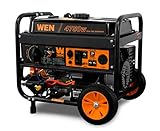
For most crews, the best commercial portable generator for a job site is a rugged 7,000–10,000-watt gasoline model with a 120/240V outlet, a published runtime at partial load, and enough weight-handling capacity for safe transport. Choose a quieter inverter for sensitive electronics or noise-restricted areas; choose a larger dual-fuel unit when extended operation and fuel flexibility matter more than easy lifting.
“Commercial” is not a uniform performance standard. Compare the manufacturer’s continuous (running) watts—not just its higher starting watts—and check the outlet, protection, and service details against the tools you will actually run. The figures below are representative published specifications for established models; versions and specifications can vary, so confirm the exact model before purchase.
As an Amazon Associate we earn from qualifying purchases at no extra cost to you.


Shortlist by job-site situation
- Regular construction work: Honda EB10000 is a high-output, professional-duty choice for crews that need substantial 120/240V capacity and can handle a heavy generator.
- Quieter work or electronics: Honda EU7000is is an enclosed inverter generator suited to smaller crews, finish work, and loads that benefit from stable power.
- Lower purchase cost and mixed loads: Westinghouse WGen9500DF is a dual-fuel option with high output for its price class. Treat its gasoline and propane wattages as separate ratings, not interchangeable capacity.
- Welding or demanding 240V equipment: Size from the tool’s input requirements and starting behavior. A portable generator is not automatically suitable for every welder; check the tool manufacturer’s guidance and generator power quality requirements.
Specifications that matter on site
| Model | Fuel and rated running output | Approx. weight | Noise / runtime context | Useful outlet or feature |
|---|---|---|---|---|
| Honda EB10000 | Gasoline; 9,000 W | About 403 lb | Open-frame; runtime depends on load and fuel use | 120/240V output; professional-duty design |
| Honda EU7000is | Gasoline; 5,500 W | About 262 lb | Enclosed inverter; rated around 52–58 dB(A), depending on load | 120/240V, inverter power, electric start |
| Westinghouse WGen9500DF | Gasoline: 9,500 W; propane: 8,500 W | About 211 lb | Open-frame; published runtime is commonly stated at 25% load, not full load | 120/240V receptacle options; dual-fuel capability |
Weights are approximate and may exclude accessories. Noise figures are not directly comparable unless measured at the same distance and load. Runtime claims are especially easy to misread: a rating at 25% load does not tell you how long the unit will run while powering heaters, compressors, and saws together. Use the manual’s load-specific data where available.
Choose by the work, not the biggest number
For several crews or high-starting-current tools
Start with the tools’ running watts, then account for the largest motor’s startup surge. A compressor, pump, or table saw can demand considerably more power for a brief moment than its steady-state draw. If tools start at the same time, their surges can overlap and trip the generator even when the sum of their running watts appears safe. The EB10000’s 9,000 running watts provide more headroom than the inverter choices here, but its 403-pound weight makes delivery, loading, and secure storage part of the purchase decision.
For finish work and sensitive equipment
The EU7000is trades maximum output for an enclosed design, lower stated noise, and inverter power. That can make it a better fit near occupied buildings or for equipment whose manufacturer calls for clean, stable power. Its 5,500 running watts still require load planning: separate sensitive electronics from high-surge tools where practical, and check the equipment manuals rather than assuming every device is compatible.
For occasional work and fuel flexibility
The WGen9500DF offers gasoline and propane operation, which can be useful when a site already manages propane or gasoline availability is uncertain. Its propane rating is lower than its gasoline rating, so size the job around the fuel you expect to use. Dual-fuel does not mean maintenance-free: gasoline left in the carburetor can still deteriorate, and propane cylinders need secure, upright storage and suitable connections.
A quick sizing calculation
Suppose a crew expects to run a 1,500-watt saw, a 1,200-watt vacuum, and 800 watts of lights and chargers. Their steady load is 3,500 watts. If the saw’s startup demand adds 1,000 watts above its running draw, a simultaneous start could briefly bring the demand to roughly 4,500 watts. A 5,500-watt generator may cover that example, but it leaves less margin for another tool or a larger-than-assumed surge. Confirm each tool’s nameplate or manual, and stagger starts when possible.
For runtime, estimate fuel consumption at your expected load rather than dividing tank capacity by a best-case runtime figure. If the manual reports 10 hours at 25% load, that is not a promise of 10 hours while operating near rated output. For a long shift, consider refueling breaks, a safe cool-down procedure, and whether the generator can be secured while unattended.
Job-site details that affect ownership
- Outlets and distribution: Match receptacles to the loads: 120V outlets for common tools, and 120/240V output when a tool or distribution panel requires it. Check outlet amperage, breaker protection, and whether a transfer switch or site distribution equipment is needed. Never backfeed a building through a wall outlet.
- Mobility: A wheel kit does not make a 200–400-pound machine easy to lift into a truck. Plan ramps, tie-down points, and enough people or lifting equipment. Keep wheels and handles clear of mud and debris so movement does not become a manual-handling hazard.
- Weather and dust: Portable generators are generally not designed to run exposed to rain or standing water. Keep the unit outdoors, on a stable dry surface, with exhaust directed away from people, doors, and air intakes. Use a purpose-built canopy only if it preserves ventilation and follows the manual; improvised covers can trap heat or exhaust.
- Noise: Open-frame generators are usually more noticeable than enclosed inverter models. Place the unit as far from workers and neighbors as practical while respecting cable limits and ventilation. Do not put it in a garage, trailer, or enclosed site box to quiet it.
- Service access: Before buying, locate the air filter, oil-fill and drain points, spark plug, battery, fuel shutoff, and service schedule in the manual. Easy access matters when oil changes and inspections are repeated across a busy season. Check that local dealers can obtain common service parts.
What wears first—and how to avoid avoidable failures
On frequently moved generators, wheels, handles, control-panel covers, and outlet doors take knocks; on engines, neglected oil, clogged air filters, stale fuel, and discharged starting batteries are common sources of trouble. Dusty cutting and demolition work can shorten air-filter life, so inspect it more often than a clean-site schedule suggests. Follow the manufacturer’s maintenance intervals, use the specified oil, and record operating hours.
Before each shift, check for fuel or oil leaks, damaged cords, loose fasteners, blocked cooling openings, and a clear exhaust path. Let the generator cool before refueling, and keep fuel containers away from hot surfaces. For storage, follow the manual’s fuel-treatment or draining instructions; simply leaving gasoline in a machine between jobs can lead to hard starting and carburetor service.
Bottom line
Choose the Honda EB10000 when sustained high output is the priority and your crew can manage its weight. Choose the Honda EU7000is when lower noise and inverter output matter more than maximum wattage. Consider the Westinghouse WGen9500DF for a lower-cost, dual-fuel route to substantial output, provided its fuel-specific ratings and service support suit your operation. In every case, verify running watts, surge needs, outlet compatibility, runtime at your real load, and safe weather protection before putting a generator to work.
Related Reviews & Guides



Best Styling Gel for Men: Hold, Shine and Flakes Compared (7 Picks)
6 Best Left Handed Golf Clubs Full Sets 2026