Last Updated: September 3, 2026
- Watch: How to Select a Left-Handed Desk Lamp for Better Lighting — Video Review
- Why Standard Desk Lamps Fail Left-Handed Users
- Look for a Flexible, Long-Reach Arm
- Choose the Right Mounting Style for Your Desk
- Prioritize Adjustable Color Temperature and Brightness
- Consider Dual-Head or Multi-Panel Designs for Wide Desks
- Tips for Setting Up Your Lamp
- Frequently Asked Questions
- Conclusion
- Related Articles
If you’re left-handed, you already know the quiet frustration of a desk lamp fighting your workspace instead of helping it. Most lamps are designed with an assumption that your dominant hand works on the right side of the page, which means the base, arm, and cord end up exactly where your hand needs to move. The result is shadows falling across your writing, awkward reaching over the lamp’s base, and a cord that snags your wrist mid-sentence.
The good news is that lighting placement matters far more than lamp “handedness” as a marketed feature, and a handful of design details (arm reach, head rotation, clamp versus base mounting, and light direction) determine whether a lamp actually works for a left-handed setup. This guide walks through what to look for in 2026, so you can pick a lamp that lights your work instead of your own hand’s shadow.
As an Amazon Associate we earn from qualifying purchases at no extra cost to you.


⚡ Save on Your Next PC — Amazon Prime
Prime members get fast free shipping on the systems above, plus early access to Prime Day & Black Friday PC deals. New members get a 30-day free trial.
Watch: How to Select a Left-Handed Desk Lamp for Better Lighting — Video Review
Why Standard Desk Lamps Fail Left-Handed Users
Lighting shadow direction comes down to simple geometry. If a lamp sits to your right and you write or type with your left hand, your hand and forearm block the light path to your paper or keyboard, casting a shadow exactly where you’re looking. Over a full workday, that forces you to hunch, tilt your head, or squint, which adds up to real eye strain and neck fatigue.
- Fixed-base lamps with short arms can’t be repositioned to the left side without light hitting your hand.
- Lamps with rigid, non-rotating heads only aim light in one factory-set direction.
- Short power cords often route across the desk from the right, crossing your writing zone.
Look for a Flexible, Long-Reach Arm
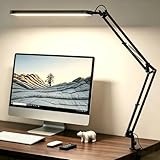
The single most useful feature for left-handed lighting is arm reach. A gooseneck or swing-arm lamp lets you physically place the light source on your left side and angle the head so illumination falls from the upper-left, over your shoulder, and onto your work area, which is the mirror image of typical right-handed placement. Look for an arm reach of at least 15-20 inches so the head can clear your hand and shoulder entirely.
- The TORCHSTAR Metal Desk Lamp uses a classic adjustable swing arm that pivots at two joints, making it easy to swing the head fully to the left and drop it low over the page.
- Gooseneck styles, like the flexible gooseneck lamp with clamp and 5 color touch control, bend into almost any angle, which is useful if your desk setup is tight or irregular.
Choose the Right Mounting Style for Your Desk
How a lamp attaches to your desk affects how much control you have over left-side placement. Clamp-mounted lamps free up desk surface and can be attached anywhere along the edge, including tucked to the far left corner. Base-mounted lamps are simpler to move around but take up desk space you may need for your left hand and elbow.
- Clamp lamps, such as the MACASA dual-head clamp lamp or the gooseneck clamp lamp, mount to the desk edge and stay out of your hand’s path entirely.
- Weighted base lamps, like the Lepro touch desk lamp, work well if you want to reposition the whole unit occasionally without unclamping it.
- Measure your desk’s edge thickness before buying a clamp lamp; most clamps fit edges up to 2 inches, but slim glass desks may need an adapter.
Prioritize Adjustable Color Temperature and Brightness
Shadow direction is only half the equation. Once the lamp is positioned correctly, the light quality itself should reduce eye strain during long sessions. Look for lamps offering at least 3 color temperature modes (warm, neutral, and daylight, roughly 3000K to 6500K) and stepless or multi-level dimming so you can match brightness to the task and time of day.
- The BOHON lamp offers 3 color modes with dimmable brightness, a solid middle-ground option for switching between reading and screen work.
- The gooseneck clamp lamp with 5 color touch control and stepless dimming gives finer control for people sensitive to glare.
- Aim for at least 400-750 lumens of output for detailed desk work; the Lepro lamp’s 750LM output is a good benchmark for a primary task light.
Consider Dual-Head or Multi-Panel Designs for Wide Desks
If your desk holds both a monitor and paper notebooks, a single light source often can’t cover both zones without one falling into shadow. Dual-head lamps solve this by letting you aim one head at your keyboard and writing surface on the left, and a second head at your monitor or reference materials.
- The MACASA dual head monitor light includes a remote, letting you adjust each head’s angle and brightness independently without leaning over the desk.
- Edge-lit panel lamps, like the LitONES soft edge-lit design, spread light across a wider, glare-reduced surface rather than a single beam, which helps when your left hand is moving across a large area.
Tips for Setting Up Your Lamp
- Position the lamp on your left side, roughly 12-16 inches from your writing hand, angled slightly forward so the beam crosses left to right.
- Route the power cord behind the desk or along the left rear leg, never across your writing zone.
- Set color temperature to around 4000K-5000K for daytime work and drop to 3000K in the evening to reduce blue light exposure.
- Test the shadow by writing a few lines before finalizing placement; if your hand casts a shadow on the pen tip, raise the head or shift it further left.
Frequently Asked Questions
Is there really such a thing as a “left-handed” desk lamp?
Not in a strict sense. No manufacturer builds a lamp exclusively for left-handed use. What matters is adjustability: a flexible arm, rotating head, and clamp or base you can position on your left side achieve the same effect as a purpose-built design.
How far should the lamp head be from my hand?
Aim for 12-16 inches between the lamp head and your writing hand, with the head raised at least 8-10 inches above the desk surface. This keeps light falling on the page without your hand blocking it or the lamp head glaring into your eyes.
What brightness and color temperature work best for reading versus screen work?
For reading and handwriting, 4000K-5000K at 400-750 lumens reduces eye strain while keeping text sharp. For screen-heavy work, a slightly warmer 3000K-3500K setting at lower brightness reduces contrast glare against your monitor.
Should I get a clamp lamp or a base lamp?
Choose a clamp lamp if desk space is limited or you want the light source tucked to the far left edge. Choose a base lamp if you want the flexibility to move it around frequently or your desk edge isn’t suitable for clamping.
Conclusion
The right desk lamp for a left-handed setup isn’t about finding a product labeled “left-handed,” it’s about choosing one with enough arm reach, head rotation, and mounting flexibility to sit comfortably on your left side without casting a shadow over your work. Prioritize adjustable color temperature, sufficient brightness, and a mounting style that fits your desk, and you’ll eliminate the shadow problem for good.
Related Reviews & Guides

8 Best Left-Handed Rulers and Measuring Tapes for Accuracy
8 Best Left-Handed Rulers: Inches and Centimeters for Lefties