Last Updated: October 8, 2026
The best knee scooters for most people are a stable four-wheel model with 8- to 9-inch wheels, a genuinely adjustable knee pad, and a turning radius small enough for the rooms you use most.
Quick picks by recovery situation
- Best all-rounder for indoor and outdoor use: KneeRover PRO, because its 9-inch front wheels, 7.5-inch rear wheels, suspension, and broad adjustment range suit uneven sidewalks as well as household floors.
- Best for a tighter budget: KneeRover Economy, if your route is mainly indoors or on smooth pavement and you can accept smaller wheels and fewer comfort features.
- Best for compact indoor maneuvering: Drive Medical DV8, whose relatively compact frame and 8-inch wheels are easier to steer through doorways and around furniture.
- Best for occasional use and storage: A lightweight folding steerable knee walker with 7.5- to 8-inch wheels. It is easier to carry, although small wheels are less forgiving outdoors.
What matters most: wheel size, turning radius, and pad adjustment
Wheel size
Wheel diameter changes both comfort and practicality. Larger front wheels roll over thresholds, cracks, driveway joints, and low carpet edges with less abrupt stopping. They also keep the knee platform more stable when the surface is imperfect. The trade-off is a larger turning arc and, sometimes, a heavier frame.
As an Amazon Associate we earn from qualifying purchases at no extra cost to you.
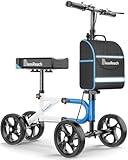

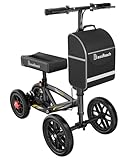
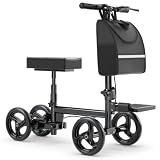
For smooth indoor floors, 7.5- or 8-inch wheels are usually sufficient. For regular outdoor use, 9-inch front wheels are preferable, especially if your route includes sidewalks or ramps. No knee scooter is a substitute for caution on gravel, wet leaves, steep slopes, or damaged pavement.
Turning radius
A small turning radius matters more indoors than outside. A scooter that needs roughly 30 inches of turning space may work well in a hallway but still require a three-point turn in a narrow bathroom. Published turning-radius figures are not always measured in the same way, so treat them as useful comparisons rather than guarantees.
Before buying, measure the narrowest doorway and the gap between your toilet, vanity, furniture, and walls. Also measure the scooter’s overall width. A tight turning radius cannot compensate for a frame that is too wide to enter the room.
Knee-pad adjustability
The pad should adjust in height and ideally fore-and-aft position. Height determines whether your injured leg can rest without forcing the hip upward or letting the knee hang too low. Fore-and-aft adjustment helps position the knee beneath your body rather than at the edge of the cushion.
When standing upright, your uninjured foot should be able to sit flat while the supported knee rests comfortably in the center of the pad. The handlebars should allow a relaxed, slightly bent elbow. If you cannot achieve that position, contact a clinician or rehabilitation professional before relying on the scooter.
Head-to-head comparison
The figures below are representative published specifications for commonly sold configurations. Model revisions and regional versions can differ, so confirm the exact specification before ordering.
| Model or type | Wheel size | Approx. weight | Weight capacity | Adjustment and maneuverability | Best use |
|---|---|---|---|---|---|
| KneeRover PRO | 9 in front; 7.5 in rear | Approx. 25 lb | 300 lb | Adjustable knee pad and handlebar; suspension; turning circle commonly listed around 30 in | Frequent indoor/outdoor recovery |
| KneeRover Economy | 8 in front and rear | Approx. 22 lb | 250 lb | Adjustable pad and handlebar; no suspension; turning circle commonly listed around 30 in | Budget use on smooth surfaces |
| Drive Medical DV8 | 8 in front and rear | Approx. 20 lb | 300 lb | Adjustable knee platform and handlebar; compact steerable frame; approximately 30 in turning circle | Indoor use with occasional pavement |
| Lightweight folding knee walker | 7.5-8 in | Approx. 18-22 lb | 250-300 lb | Multiple height positions; usually less padding and a narrower adjustment range | Short-term or occasional use |
Which one should you choose?
Choose the KneeRover PRO for mixed terrain
The PRO is the stronger choice when you expect to use the scooter every day, travel across a mixture of flooring and pavement, or want extra cushioning from its suspension. Its larger front wheels provide more clearance over small obstacles. That benefit is most noticeable when leaving a building, crossing a threshold, or rolling over a sidewalk seam.
Its disadvantages are weight, storage volume, and a potentially wider-feeling turning path. If your home has narrow rooms, check the frame width and practice turning before committing to outdoor trips.
Choose the KneeRover Economy for smooth, predictable routes
The Economy model makes sense when price is a leading factor and your normal route is hardwood, tile, low-pile carpet, or well-maintained pavement. Its 8-inch wheels offer a useful compromise without the added cost and bulk of a suspension model.
It is less appealing for frequent rough-surface use. Smaller wheels drop more sharply into cracks, and a rigid frame transfers more vibration to your hands, knee, and hips.
Choose the Drive Medical DV8 for indoor maneuvering
The DV8 is a sensible option when the scooter will spend most of its time in a home, clinic, or office. Its 8-inch wheels are large enough for normal indoor transitions while remaining easier to control around furniture than many larger outdoor-oriented designs.
For an outdoor route, inspect the tires and braking system carefully and avoid assuming that a compact frame automatically means a short turning radius. Ask the seller for the current turning specification if that measurement is not clearly published.
Indoor versus outdoor setup
| Use pattern | Preferred specification | Why it matters |
|---|---|---|
| Small apartment | 7.5-8 in wheels; narrow frame; approximately 28-30 in turning circle | Reduces collisions with doorframes and furniture |
| House with thresholds and carpet | 8-9 in front wheels; pneumatic or cushioned tires | Rolls more smoothly over transitions |
| Daily sidewalk use | 9 in front wheels; 300 lb capacity; hand brakes with a parking lock | Improves obstacle clearance and stopping control |
| Transport in a car | Folding frame; no more than about 22 lb | Makes lifting and storage more manageable |
Setup steps that prevent common problems
- Measure first. Record your narrowest doorway, the scooter’s width, and the height of your vehicle’s trunk or cargo opening.
- Set the knee pad. Start with the supported knee centered on the cushion and the thigh roughly level with the other thigh. Make small height changes rather than riding with the hip tilted.
- Set the handlebar. With both hands on the grips, aim for relaxed shoulders and slightly bent elbows. A handlebar that is too low encourages leaning heavily on the wrists.
- Test the brakes while stationary. Confirm that both brake levers engage smoothly and that the parking lock holds the scooter before mounting.
- Practice on a clear, level floor. Learn how sharply the scooter turns and how quickly it stops before approaching a threshold or ramp.
- Inspect before each longer trip. Check wheel fasteners, steering joints, brake cables, tire condition, and the knee-pad attachment.
Ownership costs and wear
A knee scooter is often rented or bought for a limited recovery period, so calculate value by use rather than purchase price alone. For example, a $180 scooter used five times per week for six weeks provides 30 uses, or about $6 per use before resale. A $45 rental used for the same six weeks costs about $7.50 per use, excluding deposits and delivery. Buying can be more economical if you can resell it or expect another period of use.
The parts most likely to need attention are wheels, brake cables, bearings, fasteners, and the foam knee pad. Hair and grit can collect around wheel axles; wipe them clean rather than applying excessive lubricant, which can attract more debris. Clean the pad with a lightly damp cloth and allow it to dry fully. Do not leave the scooter wet, overloaded, or folded while the brake cable is sharply bent.
Common mistakes include carrying bags from the handlebar, riding too quickly over thresholds, using the scooter on stairs, and ignoring a loose steering joint. A basket or approved accessory is safer than an improvised bag that interferes with the brake levers.
Final buying advice
For mainly indoor recovery, prioritize overall width, pad adjustment, and turning radius over maximum wheel size. For regular outdoor use, prioritize 9-inch front wheels, a stable frame, reliable brakes, and a capacity comfortably above your body weight plus anything you carry. Left-handed users do not usually need a special model: most steerable knee scooters have brake levers that can be operated with either hand, but verify the lever layout and practice before use.
These products provide mobility support, not a diagnosis or individualized rehabilitation plan. If the knee pad causes pain, numbness, unusual swelling, or difficulty maintaining balance, stop using the scooter and ask a healthcare professional or physical therapist to check the fit and your movement pattern.
Related Reviews & Guides


Best Tea for Weight Loss in 2026: Top Picks for Every Budget

Shop with Confidence: Our Expert-Vetted 9Marks Why Trust the Bible Pic