Last Updated: October 11, 2026
- Top 3 Picks
- Quick Comparison
- How We Chose
- 1. Zacurate 500 Series – Best for Everyday Home Checks With a Cover Included
- 2. Zacurate 500BL – Best for a Low-Cost Backup or Travel Spare
- 3. Innovo Deluxe iP900AP – Best for Alarms and Low-Perfusion Awareness
- 4. Zacurate Pro Series 500DL – Best Overall for Most Households
- 5. Vibeat Fingertip Pulse Oximeter – Best for a Simple One-Button Check
- 6. Innovo iP900BP-B – Best for App-Based Trend Tracking
- 7. CONTEC Pulse Oximeter – Best for Waveform Display on a Budget
- 8. mibest OLED Finger Pulse Oximeter – Best for Dual-Colour Display Clarity
- 9. Wellue Bluetooth Pulse Oximeter – Best for Longer Sessions and Recorded History
- 10. easy@Home Fingertip Pulse Oximeter EHP029 – Best for a Shared Family Device
- 11. SmartHeart Talking Fingertip Pulse Oximeter – Best for Low Vision and Spoken Results
- 12. HOLFENRY Pulse Oximeter – Best for a Large Display on a Tight Budget
- How to Choose
The best pulse oximeter for most homes is the Zacurate Pro Series 500DL: it combines a two-way OLED screen you can read from either orientation, a fingertip cradle that fits a wider range of adult finger sizes than the cheapest units, and a simple two-AAA power design that lasts months between battery changes. If you specifically need audible alarms and low-perfusion feedback — for example, monitoring someone with poor circulation who may not notice a falling reading on their own — the Innovo Deluxe iP900AP is the better choice, because it adds a plethysmograph waveform and a perfusion index readout that tell you whether the number on screen is trustworthy. If you want the lowest sensible spend on a device that still reads reliably from a warm, still hand, the Zacurate 500BL is the value pick. Everything below is general information, not medical advice; a fingertip oximeter is a screening and monitoring aid, and any reading that concerns you should be discussed with a clinician.
Top 3 Picks
Best overall: Zacurate Pro Series 500DL
The 500DL is the model that best balances the things that actually matter at home: a bright, rotatable OLED display, a cradle that tolerates a range of adult finger thicknesses, and a design that has stayed consistent across years of production, so replacement covers and batteries are easy to source. It is not the cheapest Zacurate and it is not the most feature-dense oximeter here, but it gets the fundamentals right and is the one most households will be happy with for years.
Best budget: Zacurate 500BL
The navy 500BL strips out the extras — no silicone cover, no lanyard, a plainer display orientation — but keeps the core measurement behavior that makes the Zacurate family a sensible default. It is the right pick as a second device for a travel bag, a spare that lives in a first-aid kit, or a first oximeter for someone who is not sure how often they will use one.
Best premium: Innovo Deluxe iP900AP
If you are monitoring a condition where the quality of the reading matters as much as the reading itself, the iP900AP’s plethysmograph and perfusion index turn a single number into something you can sanity-check. The audible alarm adds a layer of vigilance that a silent display cannot, which makes it the strongest pick for households where the person being monitored is not the person watching the screen.
Quick Comparison
Every product in this guide is compared below on the criteria that decide a home purchase: what the display shows, how well the cradle accommodates different finger sizes, what powers it, and which price tier it sits in. Exact specifications vary by production batch, so confirm the details on the current listing before buying.
| Product | Best for | Display & key features | Finger fit class | Power | Price tier |
|---|---|---|---|---|---|
| Zacurate 500 Series | Everyday home checks with cover included | Two-way OLED, silicone cover, lanyard | Adult, mid-to-wide | 2 × AAA | Mid-range |
| Zacurate 500BL | Low-cost backup and travel spare | OLED, single orientation, no cover | Adult, standard | 2 × AAA | Budget |
| Innovo Deluxe iP900AP | Alarms and low-perfusion awareness | OLED, plethysmograph, perfusion index, audible alarm | Adult, wide | 2 × AAA | Premium |
| Zacurate Pro Series 500DL | Best overall for most households | Two-way OLED, silicone cover, wide cradle | Adult, wide | 2 × AAA | Mid-range |
| Vibeat Fingertip Pulse Oximeter | Simplest possible one-button check | OLED, single-button operation | Adult, standard | 2 × AAA | Budget |
| Innovo iP900BP-B | App-based trend tracking | OLED, plethysmograph, perfusion index, Bluetooth app | Adult, wide | 2 × AAA | Premium |
| CONTEC Pulse Oximeter | Waveform display on a budget | OLED with SpO2 and pulse waveform, lanyard | Adult, standard-to-wide | 2 × AAA | Budget |
| mibest OLED Finger Pulse Oximeter | Dual-colour clarity and easy reading | OLED, dual colour, multi-directional read | Adult, standard | 2 × AAA | Mid-range |
| Wellue Bluetooth Pulse Oximeter | Longer sessions and recorded history | OLED, Bluetooth app, carry bag | Adult, standard | 2 × AAA | Premium |
| easy@Home EHP029 | Shared family device | OLED, one-button, auto power-off | Adult, standard | 2 × AAA | Mid-range |
| SmartHeart Talking Fingertip Pulse Oximeter | Low vision and spoken results | Talking audio plus visual display | Adult, standard | 2 × AAA | Premium |
| HOLFENRY Pulse Oximeter | Large display on a tight budget | Extra-large OLED, 5–8 s reading claim | Adult, standard-to-wide | 2 × AAA | Budget |
Across the whole category, the underlying measurement technology is remarkably similar: a pair of LEDs on one side of the cradle and a photodiode on the other, measuring how much red and infrared light passes through the fingertip. Most units claim an SpO2 accuracy of roughly ±2% across the 70–100% window and a pulse accuracy of roughly ±2 to ±3 bpm, with a pulse rate range that typically spans about 30–250 bpm. What separates these devices is not the sensing principle but the display, the fit, the software, the alarm behavior, and how gracefully they handle a cold or poorly perfused finger.
How We Chose
These twelve devices were selected from currently available fingertip oximeters on the basis of published specifications and category fit rather than hands-on use. The first filter was display readability: OLED screens with adjustable orientation, high contrast, or spoken output were favoured because a reading you cannot comfortably read is not a reading you will act on. The second was fit, since a cradle that clamps too loosely or too tightly produces unstable results regardless of how good the sensor is; models that explicitly accommodate a wider adult finger range scored higher. The third was measurement transparency — the presence of a plethysmograph waveform, a perfusion index, or an alarm tells the user whether a number should be trusted. The fourth was practical ownership: battery type and life, included accessories, cleaning tolerance, and whether a replacement cover or lanyard is easy to find. Finally, we weighted upgrade paths, so the list spans budget, mid-range, and premium tiers and covers the main reasons someone buys a second device — travel, sharing, low vision, or trend tracking.
1. Zacurate 500 Series – Best for Everyday Home Checks With a Cover Included
As an Amazon Associate we earn from qualifying purchases at no extra cost to you.

The Zacurate 500 Series is the middle of the Zacurate family and the one that suits a household buying a first serious oximeter — someone who wants the durability and readability of a slightly better build without paying for app connectivity or alarms they will never configure. It arrives with a silicone cover and lanyard, which sounds like a trivial inclusion until you have dropped a bare plastic oximeter on a tile floor or lost one in a drawer.
Key specifications
- Two-way OLED display that reads correctly whether the screen faces up or down, so you can insert the finger from either side
- Silicone protective cover and lanyard included, plus batteries in the box
- SpO2 measurement across the standard 70–100% window with the category-typical accuracy claim of roughly ±2% in that band
- Pulse rate displayed alongside oxygen saturation, typically spanning about 30–250 bpm
- Powered by two AAA batteries, which is the most common and most easily replaced power format in this category
- Adult fingertip cradle sized for index and middle fingers rather than thumbs
The two-way display is the feature that earns its keep. Most people take a reading sitting down, and the natural way to hold a fingertip oximeter is with the screen angled away from you on half the attempts. A rotatable readout removes that small friction entirely, which matters more than it sounds when you are taking readings twice a day for months. The silicone cover also does double duty: it protects the shell from scuffs and gives a slightly grippier surface for fingers that are stiff or shaky.
Where the 500 Series sits relative to the 500DL is mostly about fit and finish rather than measurement behaviour. Both use the same underlying approach and the same two-AAA power scheme; the Pro Series 500DL is the model with the longer track record and the cradle that tends to suit wider fingers. If your fingers are large, or if the person being monitored has fingers at the upper end of the adult range, the 500DL is the safer purchase. If your hands are average to small and you want the cover and lanyard bundled in, the 500 Series does the job.
Pros
- Two-way OLED readout removes the most common everyday annoyance with fingertip oximeters
- Silicone cover and lanyard included, which reduces the odds of a cracked shell or a lost device
- Two AAA batteries are cheap, universal, and easy to swap in a hurry
- Simple enough that a guest or a family member can use it without instruction
Cons
- No audible alarm, so it will not alert anyone who is not watching the screen
- No plethysmograph or perfusion index, so you cannot easily judge whether a weak signal is real
- Sits close in price to the Pro Series 500DL, which makes the upgrade decision worth a second look
- Cover and lanyard are small parts that are easy to misplace if the device travels between rooms
Against the Pro Series 500DL, the 500 Series is the slightly lighter-duty option. Choose the 500DL if finger size or long-term parts availability is your priority; choose the 500 Series if you want the accessories bundled and a device that is comfortable for average-sized hands. Against the 500BL, the 500 Series costs more but gives you the rotatable screen and the protective cover, both of which are worth the difference if the device will live on a bedside table rather than in a drawer.
2. Zacurate 500BL – Best for a Low-Cost Backup or Travel Spare

The Zacurate 500BL is the navy-blue, no-frills member of the family, and it is the right answer for a specific question: what is the least I can spend and still get a device whose readings I would trust for a rough check? It suits the person who already owns a better oximeter and wants a second one for a travel bag, a car, or a relative’s house — or a first-time buyer who genuinely is not sure they will use it more than a few times a year.
Key specifications
- OLED display in a single fixed orientation, with SpO2 and pulse rate shown together
- Batteries included; runs on the standard two AAA format
- SpO2 range and accuracy in line with the category norm — roughly ±2% across the 70–100% window
- Pulse rate readout across the usual 30–250 bpm span
- Compact plastic shell without the silicone cover found on the higher Zacurate models
- Adult fingertip cradle, sized for typical index and middle fingers
The 500BL’s value proposition is that it does not try to be clever. There is no alarm to configure, no app to pair, no waveform to interpret. You press the button, wait a few seconds for the reading to settle, and read two numbers. For a device that lives in a suitcase and gets used twice a holiday, that simplicity is the feature. There is also less to go wrong: fewer menu states means fewer accidental settings changes, and the absence of a cover means one less small part to lose.
The trade-offs are predictable. Without the rotatable display, roughly half of your attempts will have the screen facing the wrong way until you build the habit of checking orientation before inserting the finger. Without the silicone cover, the shell picks up scuffs and the plastic can feel slick against a dry finger. And without a plethysmograph, you get no visual confirmation that the sensor is tracking a clean pulse — if the number looks odd, your only recourse is to warm the hand and try again.
Pros
- Lowest-cost way to keep a genuine second oximeter available
- Two AAA batteries are included and replaceable anywhere
- Operation is a single button, which makes it easy to hand to someone else
- Small and light enough to live permanently in a travel kit
Cons
- Fixed display orientation is noticeably less convenient than a two-way screen
- No silicone cover, so the shell is more exposed to drops and scratches
- No alarm, waveform, or perfusion index for judging signal quality
- Battery contacts are the first thing to corrode if the device is stored with cells installed for years
Compared with the Zacurate 500 Series, the 500BL is the device you buy when you want a working oximeter and nothing else. The 500 Series is worth the step up if the device will see regular use at home; the 500BL is the smarter buy if it will sit unused for months at a time. Compared with the Vibeat, the two are close in intent — the choice comes down to which cradle fits your fingers more comfortably, and that is worth checking against the published finger-size guidance on each listing.
3. Innovo Deluxe iP900AP – Best for Alarms and Low-Perfusion Awareness
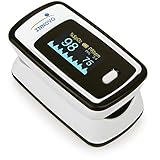
The Innovo Deluxe iP900AP is the pick for households where the reading needs to be interrogated, not just displayed. It suits someone monitoring a chronic respiratory or cardiac condition, a caregiver watching an elderly parent, or anyone whose circulation is poor enough that a bare number on a screen is not enough information. It is the most feature-dense device in this guide alongside its app-enabled sibling.
Key specifications
- OLED display showing SpO2, pulse rate, and a plethysmograph waveform
- Perfusion index readout, which indicates the strength of the pulse signal at the sensor site
- Audible alarm that can be configured to sound when readings fall outside a chosen range
- SpO2 accuracy in the category-typical ±2% band across 70–100%, with pulse accuracy of roughly ±2 to ±3 bpm
- Two AAA batteries, the standard power format for fingertip oximeters
- Multi-directional display orientation and a cradle designed for a wider range of adult finger sizes
The plethysmograph is the feature that changes how you use the device. It is a small scrolling waveform representing the pulsatile flow the sensor is detecting. When the trace is smooth and regular, the SpO2 number beside it is being derived from a good signal. When the trace is flat, jagged, or wandering, the number is suspect regardless of what it says — and that distinction is invisible on a basic oximeter. The perfusion index does something similar in a single figure: a very low value suggests the sensor is struggling, which is common with cold hands, low blood pressure, or poor peripheral circulation.
The alarm is genuinely useful in a caregiving context, but it needs to be set thoughtfully. An alarm threshold that is too close to a normal resting value will sound constantly and get ignored; one that is too far away will not warn you in time. A reasonable approach is to agree a threshold with a clinician, write it down, and check it has not been accidentally changed before each monitoring session.
Pros
- Plethysmograph waveform lets you judge signal quality rather than trusting a number blindly
- Perfusion index gives a quick read on whether the finger is being measured well
- Configurable audible alarm is valuable when the monitored person is not watching the screen
- Multi-directional display and a generous cradle suit a wide range of adult fingers
Cons
- Premium price for features that a healthy user checking occasionally will never use
- More settings mean more opportunity for an accidental change
- Alarms can cause unnecessary anxiety if the threshold is set poorly
- Waveform interpretation takes practice and is not a substitute for clinical assessment
Compared with the Innovo iP900BP-B, the iP900AP is the version to choose if you want everything self-contained on the device. The iP900BP-B adds Bluetooth and an app for recording and reviewing readings over time, which is more useful for spotting trends than for spot checks. If your need is “tell me now, and tell me loudly,” the iP900AP is the better fit; if your need is “show me the last two weeks,” the iP900BP-B is. Compared with the Zacurate Pro Series 500DL, the Innovo is a clear step up in diagnostic transparency but a significant step up in price — worth it only if you will actually use the waveform and the alarm.
4. Zacurate Pro Series 500DL – Best Overall for Most Households

The Zacurate Pro Series 500DL is the device most people should buy. It has been one of the most widely used home fingertip oximeters for years, which matters for two practical reasons: replacement silicone covers and lanyards are easy to find, and the behaviour of the device is well documented by a large user base rather than a single marketing page. It suits a household that wants one dependable oximeter for occasional checks, a bedside drawer, and the odd illness.
Key specifications
- Two-way OLED display readable with the screen facing either up or down
- Silicone cover and lanyard included; batteries included
- SpO2 measurement across the standard 70–100% range with the category-typical ±2% accuracy claim
- Pulse rate shown alongside saturation, typically across a 30–250 bpm span
- Two AAA batteries, giving months of typical home use per set
- Adult fingertip cradle that accommodates a wider range of finger thicknesses than the entry-level model
The reason the 500DL keeps coming out on top is that it makes very few compromises in the places that matter. The rotatable display means you never fight the orientation. The cradle holds a range of adult fingers firmly without pinching. The screen is bright enough to read in a dim bedroom without switching on a lamp. And the whole thing runs on the most replaceable battery format there is, so a dead oximeter is a two-minute problem rather than a shopping trip.
What it does not have is any way to tell you whether the number is good. There is no waveform, no perfusion index, and no alarm. For a healthy adult taking an occasional reading, that is fine — you warm your hands, sit still, and the number is what it is. For anyone monitoring a condition where a false low reading would trigger a phone call or a panic, the absence of signal-quality feedback is the main reason to consider the Innovo Deluxe instead.
Pros
- Two-way OLED display is genuinely convenient in daily use
- Wide, comfortable cradle fits a broader range of adult fingers than budget units
- Long production history means covers, lanyards, and documentation are easy to find
- Simple two-button operation that anyone in the household can manage
Cons
- No waveform, perfusion index, or alarm for judging signal quality
- Costs more than the 500BL for largely the same measurement principle
- Silicone cover can stretch or discolour over a few years of handling
- Not designed for continuous monitoring or overnight recording
Against the Zacurate 500 Series, the 500DL is the better long-term purchase for most people because of the cradle fit and the longer track record; the 500 Series makes more sense if you find it at a better price and your fingers are average-sized. Against the Innovo Deluxe iP900AP, the 500DL wins on simplicity and cost and loses on diagnostic depth. If you have never needed an alarm before, you almost certainly do not need one now — and the 500DL is the more pleasant device to own.
5. Vibeat Fingertip Pulse Oximeter – Best for a Simple One-Button Check
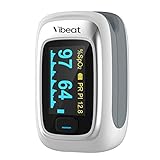
The Vibeat is aimed at the person who wants the smallest possible interaction with the device: insert finger, press button, read two numbers, put it away. It suits occasional users, travellers, and anyone who has found that a complicated oximeter ends up staying in its box. It is a budget-tier device, and it should be judged on that basis.
Key specifications
- OLED display showing SpO2 and pulse rate simultaneously
- Single-button operation with automatic power-off after a period of inactivity
- SpO2 range in the standard 70–100% window with the category-typical accuracy claim
- Pulse rate readout across the usual 30–250 bpm span
- Two AAA batteries, the most common power format in this category
- Compact adult fingertip cradle intended for index and middle fingers
The advantage of a one-button device is that there is nothing to get wrong. There is no menu to navigate into by accident, no threshold to reset, no pairing step to forget. If you are handing an oximeter to a neighbour, a babysitter, or a relative who is not comfortable with gadgets, that simplicity has real value. The automatic power-off also means the batteries survive being left in a drawer.
The trade-off is that you get no context for the number. If the reading looks low, you have no way to see whether the sensor was struggling or whether the reading is real. The practical mitigation is procedural: warm the hands first, remove any nail polish, sit still for a minute, and take three readings a minute apart. If all three agree within a point or two, you can be reasonably confident. If they disagree wildly, treat the session as failed and try again with warmer hands.
Pros
- Simplest possible operation — one button, two numbers, automatic shut-off
- Compact and light, easy to keep in a bag or a bedside drawer
- Budget-tier price makes a second device for travel an easy decision
- Two AAA batteries are cheap and available everywhere
Cons
- No waveform, perfusion index, or alarm
- Display is not rotatable, so orientation must be checked before each use
- Standard-size cradle may feel tight on larger fingers
- No protective cover included, so the shell is exposed to drops
Against the Zacurate 500BL, the Vibeat is the same idea executed slightly differently. Both are budget devices with a single orientation and no signal-quality feedback. The deciding factor is fit: check the published finger-size range on each listing and pick the one that matches your hands, because a cradle that pinches will give you worse readings than a cradle that fits, regardless of brand. Against the CONTEC, the Vibeat is the simpler device — the CONTEC offers a waveform, which is the one budget-tier feature worth paying a little more for if you want to judge signal quality without stepping up to a premium model.
6. Innovo iP900BP-B – Best for App-Based Trend Tracking

The Innovo iP900BP-B is the version of the Innovo platform built around recorded history. It suits someone who needs to show a pattern to a clinician — a person tracking their own recovery over weeks, or a caregiver who wants to describe what has been happening rather than recall it. It shares the measurement features of the iP900AP and adds a Bluetooth link to a free app.
Key specifications
- OLED display with SpO2, pulse rate, and plethysmograph waveform
- Perfusion index readout for judging signal strength at the fingertip
- Bluetooth connection to a free companion app for storing and reviewing readings
- SpO2 accuracy in the category-typical ±2% band across 70–100%
- Two AAA batteries, standard format and widely available
- Multi-directional display and a cradle sized for a wide range of adult fingers
The app is the reason to choose this model over the iP900AP. A single reading taken in isolation tells you very little; a series of readings taken at the same time each day tells you whether things are stable, improving, or drifting. If you are preparing for an appointment, a stored list of readings with timestamps is far more useful than trying to remember whether yesterday morning was better than Tuesday evening. The trade-off is that you now depend on a phone, a charged battery, and an app that must keep working — three failure points that a paper notebook does not have.
It is worth being clear about what the app does and does not do. It records and displays readings; it does not diagnose anything, and a trend line on a phone screen is not a clinical assessment. Use it as a memory aid and a way to communicate, not as a substitute for advice.
Pros
- Stored readings with timestamps make it easy to describe a pattern to a clinician
- Plethysmograph and perfusion index let you verify that recorded readings came from a good signal
- Multi-directional display and generous cradle fit a wide range of adult fingers
- Works as a standalone oximeter even if you never open the app
Cons
- Premium price, and the app adds a dependency that a basic device does not have
- Bluetooth pairing and app updates can become a chore over years of ownership
- Recorded data is only as good as the conditions you measured under — inconsistent timing makes trends meaningless
- No benefit at all if you only ever take one-off spot readings
Against the Innovo Deluxe iP900AP, the choice is straightforward: pick the iP900AP if you want an alarm and everything on-device, and the iP900BP-B if you want a record you can review later. You cannot easily have both in one device at this price point. Against the Wellue Bluetooth model, the Innovo leans more toward clinical transparency with its perfusion index and alarm heritage, while the Wellue leans toward convenience and longer recording sessions. If you want to hand a printout or a screen to a doctor, either works; the Innovo is the one with more on-device interpretation built in.
7. CONTEC Pulse Oximeter – Best for Waveform Display on a Budget

The CONTEC fingertip oximeter is the budget-tier device that gives you something most cheap oximeters do not: a waveform. CONTEC is a long-established manufacturer of patient-monitoring equipment, and this fingertip unit borrows the same visual language as its clinical devices. It suits a user who wants to see signal quality without paying premium prices, and who does not mind a slightly more utilitarian design.
Key specifications
- OLED display showing SpO2, pulse rate, and a waveform trace
- Lanyard included for hanging the device on a hook or bed rail
- SpO2 range in the standard 70–100% window with the category-typical accuracy claim
- Pulse rate readout across the usual 30–250 bpm span
- Two AAA batteries, standard and easily replaced
- Adult fingertip cradle sized for standard to slightly wider fingers
The waveform is the entire reason to consider this device over the other budget options. Watching the trace settle into a smooth, regular pattern before you trust the number is a habit that improves reading quality more than any other single change. If the trace is ragged or absent, you know immediately that you need to warm the hand, reposition the finger, or remove nail polish rather than wondering why the number keeps jumping.
What you do not get is an alarm or a perfusion index, so the waveform is your only signal-quality cue. That is still a meaningful advantage at this price. The device also does without the silicone cover and the rotatable display found on the mid-range Zacurate models, which means it is more exposed to scuffs and slightly less convenient to read from a seated position.
Pros
- Waveform display at a budget-tier price is unusual and genuinely useful
- Lanyard included makes it easy to keep the device accessible at a bedside
- Simple operation with no app, pairing, or configuration required
- Two AAA batteries keep running costs near zero
Cons
- No alarm or perfusion index — the waveform is your only quality check
- Fixed display orientation is less convenient than a two-way screen
- No silicone cover included, so the shell is more vulnerable to drops
- Design is functional rather than polished, which matters to some buyers
Against the Vibeat and the Zacurate 500BL, the CONTEC is the budget device to pick if you care about signal quality, because it is the only one of the three that shows you a trace. Against the Innovo Deluxe iP900AP, the CONTEC gives you a stripped-down version of the same idea: you can see the waveform, but you cannot set an alarm or read a perfusion index. If budget is the constraint and you want the most diagnostic value per pound, the CONTEC is the strongest budget pick in this guide.
8. mibest OLED Finger Pulse Oximeter – Best for Dual-Colour Display Clarity

The mibest OLED oximeter is a mid-range device whose selling point is legibility. It uses a dual-colour OLED display with the white and black finish variants, and it is designed so that the two numbers on screen are visually distinct at a glance. It suits someone who finds that colour-coded readouts are easier to parse quickly, and anyone who wants a slightly better screen than the entry-level units without stepping up to a connected device.
Key specifications
- Dual-colour OLED display that separates the SpO2 and pulse rate readouts visually
- Multi-directional display, so the reading can be viewed from more than one orientation
- SpO2 measurement across the standard 70–100% range with the category-typical ±2% accuracy claim
- Pulse rate displayed alongside saturation, typically across 30–250 bpm
- Two AAA batteries, the standard power format
- Adult fingertip cradle sized for typical index and middle fingers
The value of a dual-colour display is small but real. When you are tired, unwell, or reading a screen in a dim room, having oxygen saturation in one colour and pulse rate in another reduces the chance of reading the wrong figure — a mistake that is surprisingly easy to make when both numbers are the same shade and similar in length. It is a small usability gain, but it is the kind of thing you notice every time you use the device.
The rest of the package is standard mid-range fare: two AAA batteries, a straightforward cradle, and no app or alarm. There is nothing here that will change how you monitor anything; it is simply a well-executed basic oximeter with a nicer screen than most.
Pros
- Dual-colour display makes the two readings harder to confuse
- Multi-directional viewing is more convenient than a fixed-orientation screen
- Available in white and black finishes to match a bedside aesthetic
- Straightforward operation with no app dependency
Cons
- No waveform, perfusion index, or alarm for judging signal quality
- Standard cradle may be tight on larger fingers
- Mid-range price for a device that measures the same way as a budget unit
- Dual-colour styling is a convenience, not a measurement improvement
Against the Zacurate Pro Series 500DL, the mibest competes on screen design while the 500DL competes on cradle fit and long-term parts availability. If your fingers are large, the 500DL is the safer choice; if you want the clearest possible two-number readout and your fingers are average, the mibest is a reasonable pick. Against the easy@Home EHP029, the two occupy very similar ground — both are mid-range, both are simple, and the decision comes down to which display you find easier to read and which cradle fits your hand.
9. Wellue Bluetooth Pulse Oximeter – Best for Longer Sessions and Recorded History

The Wellue Bluetooth fingertip oximeter is the pick for someone who wants to record readings over time without managing a clinical-style device. Wellue is known for connected monitoring products, and this model pairs an OLED display with a free app and ships with a carry bag. It suits a user tracking recovery, monitoring a changing condition, or simply wanting a record they can look back at.
Key specifications
- OLED display for standalone use, with SpO2 and pulse rate readouts
- Bluetooth connection to a free companion app for recording and reviewing readings
- Carry bag included, which makes it easier to keep the device clean and together
- SpO2 accuracy in the category-typical ±2% band across 70–100%
- Two AAA batteries, standard format and widely available
- Adult fingertip cradle sized for typical index and middle fingers
The app is the reason to choose Wellue over a standalone device. Recording a reading takes a few seconds longer than reading it off the screen, but the payoff is a history you can scroll through rather than a memory you have to trust. For anyone preparing for a follow-up appointment, that history is the difference between “I think it has been about the same” and a list of dated values.
The carry bag is a small inclusion that matters more than it looks. Fingertip oximeters collect dust in the sensor window and lint in the cradle, and both degrade readings. A bag that keeps the device closed between uses reduces how often you need to clean it, and makes it far more likely that the device is where you expect it to be.
Pros
- App recording turns scattered spot checks into a reviewable history
- Carry bag protects the sensor window and keeps the device together
- Works as a plain oximeter if you do not want to use the app
- Two AAA batteries keep long-term running costs negligible
Cons
- Premium price for a device whose core measurement matches cheaper models
- App dependency means a phone and a working connection are part of the workflow
- No alarm for unattended monitoring
- Standard cradle size may not suit larger fingers
Against the Innovo iP900BP-B, the Wellue is the more consumer-friendly connected device, while the Innovo brings a perfusion index and a stronger clinical heritage. If you want to see whether the signal was good at the moment of measurement, the Innovo tells you more; if you want a simple recorded history and a bag to keep it in, the Wellue is the easier device to live with. Against the easy@Home EHP029, the Wellue is the upgrade — same simple measurement, plus a record.
10. easy@Home Fingertip Pulse Oximeter EHP029 – Best for a Shared Family Device

The easy@Home EHP029 is a mid-range, single-button oximeter that suits a household where more than one person uses the same device. easy@Home is a well-known home-health brand, and the EHP029 follows the pattern of its other products: straightforward, plainly labelled, and designed to be handed around. It is a sensible pick for a family first-aid drawer.
Key specifications
- OLED display showing SpO2 and pulse rate together
- One-button operation with automatic power-off to preserve battery life
- SpO2 measurement across the standard 70–100% range with the category-typical ±2% accuracy claim
- Pulse rate readout across the usual 30–250 bpm span
- Two AAA batteries, standard and easily replaced
- Adult fingertip cradle sized for typical index and middle fingers
When a device is shared, consistency matters more than features. Everyone in the house should use the same finger, take the reading sitting down after a minute of rest, and record the number the same way. A single-button oximeter makes that routine easy to teach and hard to get wrong. The automatic power-off is also a quiet benefit in a shared device, because the most common cause of a dead oximeter is someone leaving it switched on in a drawer.
The limitation is the familiar one: no waveform, no perfusion index, no alarm. For a family doing occasional checks during a respiratory illness, that is acceptable. For anyone monitoring a serious condition, it is not the right device — the Innovo or Wellue models give you more to work with.
Pros
- Single-button operation is easy to teach to multiple household members
- Automatic power-off reduces dead-battery surprises
- Mid-range price with a well-known home-health brand behind it
- Two AAA batteries are cheap to keep in stock
Cons
- No signal-quality feedback of any kind
- Fixed display orientation
- No cover or carry case included
- Shared use means shared hygiene responsibilities — the cradle needs wiping between users
Against the mibest OLED, the easy@Home is the plainer device; the mibest wins on screen clarity and colour separation, while the easy@Home wins on brand familiarity and simple operation. Against the Wellue Bluetooth, the easy@Home is the device for a household that does not want an app — no pairing, no phone, no records to maintain. If your goal is a reliable shared device that anyone can pick up and use correctly on the first try, the EHP029 is a solid choice.
11. SmartHeart Talking Fingertip Pulse Oximeter – Best for Low Vision and Spoken Results

The SmartHeart Talking Fingertip Pulse Oximeter is the specialist pick in this guide. It speaks the readings aloud as well as displaying them, which makes it the right device for anyone with low vision, anyone who struggles to read a small OLED screen, and anyone who wants a reading confirmed without putting on glasses. It is a premium-tier device because the audio hardware and voice chip add cost.
Key specifications
- Spoken announcement of oxygen saturation and pulse rate in addition to the visual display
- Visual OLED readout for users who prefer to read the numbers
- SpO2 measurement across the standard 70–100% range with the category-typical ±2% accuracy claim
- Pulse rate readout across the usual 30–250 bpm span
- Two AAA batteries, standard format
- Adult fingertip cradle sized for typical index and middle fingers
For someone with macular degeneration, cataracts, or simply a strong prescription, a talking oximeter removes the single biggest barrier to using the device independently. Instead of holding the screen at arm’s length and squinting, the user inserts a finger and listens. That independence is worth a great deal, and it is the reason this model exists despite costing more than devices with identical measurement capability.
The practical considerations are audio-related rather than measurement-related. Speech volume needs to be adequate for a user with hearing loss, background noise can make the announcement hard to catch, and the announcement itself takes a few seconds — so a user needs to wait rather than assume the reading has been missed. It is also worth checking whether the device can be used silently, because a talking oximeter in a shared bedroom at night is a consideration.
Pros
- Spoken readings make independent use possible for people with low vision
- Dual output — audio and visual — suits a wide range of users
- Simple operation with no app or pairing required
- Two AAA batteries keep running costs low despite the premium price
Cons
- Premium price for measurement hardware that is otherwise standard
- Speech can be hard to hear over background noise or for users with hearing loss
- No waveform, perfusion index, or alarm
- Audio may be disruptive in a shared room at night
Against the easy@Home EHP029, the SmartHeart does the same job with the addition of speech, and that addition is decisive for the users who need it. Against the Innovo Deluxe iP900AP, the choice is between accessibility and diagnostics: the SmartHeart tells you the number clearly, while the Innovo tells you whether the number is trustworthy. For a user with low vision who simply wants to know their saturation, the SmartHeart is the more useful device; for a caregiver interpreting readings, the Innovo is.
12. HOLFENRY Pulse Oximeter – Best for a Large Display on a Tight Budget

The HOLFENRY fingertip oximeter is a budget-tier device built around a large display. Its listing emphasises a fast reading — in the region of five to eight seconds — and an oversized readout for SpO2 and heart rate. It suits someone who wants the numbers to be big and obvious without paying mid-range prices, and who is willing to accept a plainer feature set in exchange.
Key specifications
- Extra-large OLED display with prominent SpO2 and heart rate readouts
- Listing states a fast reading time in the region of 5–8 seconds
- SpO2 measurement across the standard 70–100% range with the category-typical ±2% accuracy claim
- Pulse rate readout across the usual 30–250 bpm span
- Two AAA batteries, standard format
- Adult fingertip cradle sized for standard to slightly wider fingers
A large display is not a gimmick. The single most common complaint about fingertip oximeters is that the numbers are small, and the single most common mistake is misreading which number is which. A larger, clearer readout addresses both problems at once, and it does so for users who may not think of themselves as having any vision difficulty — anyone over fifty will notice the difference.
The fast reading claim should be treated with a little caution, not because it is wrong, but because a reading that appears quickly is not necessarily settled. Most oximeters lock onto a stable value within a few seconds when perfusion is good, but the number can continue to drift for another ten or fifteen seconds. The habit worth building is to wait for the value to stop changing before you write it down, regardless of how quickly the device first shows something.
Pros
- Large, high-contrast readout is easier to read than most budget oximeters
- Fast initial reading is convenient for quick checks
- Budget-tier price makes it an easy second device
- Two AAA batteries are cheap and universally available
Cons
- No waveform, perfusion index, or alarm
- Fast first reading can be mistaken for a settled reading
- Budget build quality means the shell and cradle are more likely to be the first things to show wear
- No protective cover or carry case included
Against the CONTEC, the HOLFENRY trades the waveform for a bigger display. If you want to judge signal quality on a budget, choose the CONTEC; if you want the numbers to be unmistakable, choose the HOLFENRY. Against the Zacurate 500BL, the HOLFENRY is the better pick for anyone who struggles with small text, while the 500BL is the better pick for anyone who prioritises a long-established device with easily sourced accessories.
How to Choose
Fingertip oximeters look almost identical, and the specifications on the box are nearly interchangeable. The differences that actually affect your experience at home come down to seven things: display readability, measurement consistency, fit across finger sizes, performance when perfusion is poor, alarm behaviour, battery life, and the practical limits of what the device can tell you. Work through them in that order and the shortlist writes itself.
Start with the display, because it is what you use every time
A two-way or multi-directional OLED screen means you can read the device from either orientation, which removes the small daily annoyance of inserting a finger and discovering the screen is facing the wrong way. Dual-colour displays separate the saturation and pulse readings so you do not confuse them.
Related Reviews & Guides


Best All-Terrain Electric Wheelchairs for Adults
Best Smart Air Conditioners for Every Room Size