Last Updated: October 11, 2026
- Best Hydrafacial Machines for Home and Spa Use in 2026
- Quick picks by situation
- Head-to-head: professional Hydrafacial systems versus generic machines
- Specifications that matter more than the feature count
- Tip types and what they change
- Serum compatibility: the overlooked buying decision
- Setup and maintenance that protect the pump
- Worked ownership calculation
- Safety and suitability
- Bottom line
- Top Pick: Hydrogen Oxygen Facial Care Machine Professional 6 in 1
- Best Value: Hydrogen Oxygen 7 in 1 Multifunctional Facial Care Machine – Skin Care Device for Beauty Salon Home Spa Use
- Premium Choice: Hydrogen Oxygen Facial Machine, Hydro Facial Machine & Hydrodermabrasion Machine for Skin Care, Facial Vacuum Pore Cleaner, Hydro Dermabrasion Machine for Deep Cleansing & Hydration, Home Use
Best Hydrafacial Machines for Home and Spa Use in 2026
The best Hydrafacial machine depends on whether you need a licensed professional system with controlled vacuum and proprietary solutions, or a compact at-home hydrodermabrasion device for occasional surface exfoliation; for most spas, the Hydrafacial Syndeo is the strongest all-round choice, while home users are better served by a low-pressure, three-in-one hydrodermabrasion device with replaceable tips and clear cleaning instructions.
“Hydrafacial” is also a brand name, not just a description of wet exfoliation. Genuine Hydrafacial systems use the company’s branded handpieces, tips and solutions, whereas many lower-cost devices are more accurately called hydrodermabrasion, aqua-peeling or water-peeling machines. They can perform similar broad steps—cleansing, exfoliation, liquid infusion and suction—but they are not automatically interchangeable with a Hydrafacial treatment.
As an Amazon Associate we earn from qualifying purchases at no extra cost to you.



Quick picks by situation
| Situation | Best fit | Why | Typical 2026 market range |
|---|---|---|---|
| Busy medical spa or high treatment volume | Hydrafacial Syndeo | Integrated touchscreen workflow, branded solutions and professional consumables | Usually quoted by authorized dealers; commonly several thousand to five figures |
| Established spa seeking a proven professional platform | Hydrafacial MD | Professional-grade wet exfoliation and vacuum treatment in a familiar format | Often several thousand dollars, depending on configuration and condition |
| Solo esthetician building a service menu | Professional hydrodermabrasion machine with adjustable vacuum | Lower entry cost and broader solution compatibility than a proprietary platform | About $700–$3,000 for many commercial-grade units |
| Small room, occasional personal use | Compact home aqua-peeling device | Smaller footprint and simpler operation, provided suction is conservative | About $80–$400 |
| First-time home user worried about irritation | Low-pressure water-based exfoliation device | More controllable than a high-vacuum multifunction unit | About $100–$300 |
Head-to-head: professional Hydrafacial systems versus generic machines
Hydrafacial Syndeo
The Syndeo is aimed at professional providers who want a guided, repeatable treatment process. Its appeal is less about a single headline suction number and more about the complete system: a professional console, touchscreen guidance, branded treatment solutions, dedicated tips and a supplier-supported workflow. That consistency can matter when several practitioners use the same machine.
The trade-off is ownership cost. Proprietary tips and solutions can cost more than generic supplies, and the business may need authorized training, service and approved consumables. It is a poor value for someone who expects to perform only a few treatments per month at home.
Hydrafacial MD
Hydrafacial MD is an established professional platform designed for clinic and spa treatment rooms. It is a sensible option when a provider values the Hydrafacial protocol and support ecosystem but does not need the newer Syndeo interface. When considering a used unit, condition and service history are more important than the model name alone.
Ask for records showing pump servicing, handpiece condition, solution-line replacement and electrical safety checks. A discounted machine with a worn vacuum pump or blocked internal tubing can become more expensive than a supported new system.
Generic hydrodermabrasion and aqua-peeling machines
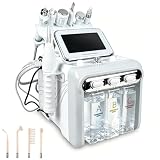
Generic machines usually combine a hydrodermabrasion handpiece with functions such as spray, oxygen mist, ultrasonic spatula, cold hammer or high-frequency current. The extra modes may be useful, but they should not distract from the essentials: stable suction adjustment, smooth liquid flow, easily replaced tubing and tips that can actually be disinfected.
The main advantage is flexibility. Many units accept compatible water-based solutions rather than one proprietary line. The disadvantage is variation: published vacuum figures may be unclear, adapters may leak, and the included tips may be poorly finished. Buy from a supplier that provides a manual, replacement parts and electrical specifications—not merely a long list of beauty functions.
Specifications that matter more than the feature count
| Specification | Useful target for home use | Useful target for professional use | Why it matters |
|---|---|---|---|
| Vacuum adjustment | At least 3 settings, beginning below 50 kPa | Continuous or fine adjustment across roughly 20–70 kPa | Allows the operator to match suction to location and tolerance |
| Solution reservoir | 100–250 mL | 250–500 mL or separate clean and waste tanks | Reduces refilling at home or interruptions between clients |
| Waste container | At least 150 mL | 500 mL or more | Helps prevent overflow and makes used fluid visible for cleanup |
| Handpiece tips | 3–5 smooth, clearly sized tips | Several tip sizes plus a replacement supply channel | Tip diameter and texture affect comfort, coverage and clogging |
| Footprint | Under about 30 × 25 cm | Approximately 35–55 cm wide on a cart or console | Shows whether the unit suits a bathroom cabinet or treatment room |
| Noise | Preferably under 65 dB | Approximately 55–70 dB | A quieter pump makes longer treatments more comfortable |
Do not compare vacuum readings unless the manufacturer states the measurement method. “kPa,” “bar,” and “inHg” are different units, and maximum vacuum is not the same as useful working suction at the tip. A machine with a lower maximum but smooth control can be easier to use safely than a powerful unit with only two aggressive settings.
Tip types and what they change
- Spiral or vortex tips: Common on professional wet-exfoliation systems. Their internal channels help move solution across the skin while suction lifts loosened debris. They are effective only when kept moving and supplied with enough fluid.
- Smooth flat tips: Easier to clean and often more forgiving for beginners. They usually cover a wider area but may provide less concentrated exfoliation.
- Small precision tips: Useful around the nose and other small areas. They can concentrate suction, so they require lighter pressure and shorter passes.
- Diamond or abrasive tips: These are dry microdermabrasion-style attachments rather than a complete Hydrafacial treatment. They can increase exfoliation but also increase the importance of conservative settings and suitable skin assessment.
- Silicone tips: Flexible and comfortable, but they may not produce the same exfoliating action as a textured or spiral tip. Their advantage is often easier cleaning and gentler contact.
Serum compatibility: the overlooked buying decision
Use only solutions that the device manufacturer says are compatible with its pump, tubing and reservoir. Water-based, low-viscosity solutions are generally easier for small pumps to handle. Oils, suspensions, thick gels and products with particles can clog narrow lines, damage seals or separate inside the system.
Check whether the machine uses one reservoir or separate bottles for solution and waste. Also check whether the solution touches reusable internal tubing. If it does, flushing is not optional. A device that accepts a favorite serum but cannot be fully rinsed may create more maintenance trouble than convenience.
For professional use, keep product labeling, lot information and contraindication guidance available. Cosmetic serums should not be treated as sterile products, and an infusion claim does not make a solution appropriate for injection or broken skin.
Setup and maintenance that protect the pump
- Inspect the tip and tubing before use. Look for cracks, cloudiness, kinks or dried residue. A partial blockage can make suction fluctuate.
- Fill the clean-solution reservoir only to its marked limit. Overfilling can force liquid into areas that are not designed to hold it.
- Prime the line with the correct solution. Run fluid until the stream is steady before placing the tip on skin. This prevents a dry pass and reduces the chance of pulling air through the pump.
- Start at the lowest effective suction. Keep the handpiece moving rather than holding it in one spot. Avoid the eyelids, damaged skin and areas where suction is uncomfortable.
- Flush immediately after treatment. Run the manufacturer-approved rinse volume through the solution path, then empty the waste tank.
- Clean removable parts separately. Wash and disinfect reusable components according to the manual. Do not assume that wiping the outside disinfects the internal fluid path.
- Dry before storage. Leaving water or serum in tubing encourages odor, residue and microbial growth. Store tips protected from dust.
The parts most likely to wear first are silicone seals, tubing connections, handpiece O-rings, narrow tip channels and the vacuum pump. Keep replacement seals and tips available for a professional practice. If suction becomes weak, first check for a full waste tank, loose cap, clogged tip or kinked tube before assuming the motor has failed.
Worked ownership calculation
Suppose a $1,200 generic professional machine uses $6 of solution and disposable or replacement-tip cost per treatment. At 10 treatments each month, the equipment portion over 24 months is $1,200 ÷ 240 = $5 per treatment. The basic consumable cost is therefore about $11 per treatment before labor, rent, cleaning supplies, training, tax and servicing.
At two personal treatments per month, the same equipment portion would be $1,200 ÷ 48 = $25 per treatment, before consumables. That is why a compact home machine may be financially more sensible for occasional use, even if its reservoir and tip selection are less sophisticated.
Safety and suitability
Hydrodermabrasion is not appropriate for every skin condition or treatment schedule. Avoid using suction over open wounds, active irritation, recently treated areas or skin that is unusually fragile. People using prescription skin treatments, receiving recent cosmetic procedures, or managing a skin condition should ask a qualified healthcare or skincare professional whether this type of treatment is suitable.
For home use, choose the lowest effective setting, do not share reusable tips without proper reprocessing, and stop if there is significant pain, persistent redness, swelling or blistering. Professional providers should follow local sanitation, licensing and device-use requirements.
Bottom line
Choose the Hydrafacial Syndeo when workflow consistency, branded protocols and professional support justify the higher ownership cost. Choose Hydrafacial MD when you want an established professional platform and can verify service history. Choose a generic hydrodermabrasion machine when adjustable suction, replaceable tips and broader solution compatibility matter more than a proprietary ecosystem. For home users, prioritize low-pressure control, a small reservoir, simple cleaning and readily available replacement parts over maximum suction or a long list of add-on modes.
Related Reviews & Guides
Best Smart Air Conditioners for Every Room Size
Best 85mm Lenses for Portraits and Everyday Use