Last Updated: October 11, 2026
- Top 3 Picks
- Quick Comparison
- How We Chose
- 1. Kitchen in the box 3.2Qt Stand Mixer – Best for Tiny Kitchens and Light Batters
- 2. KitchenAid Artisan 5-Qt Tilt Head Stand Mixer, KSM150PS – Best Overall for Most Home Bakers
- 3. VIVOHOME 6-Quart Tilt-Head Kitchen Mixer – Best for Larger Batches on a Mid-Range Budget
- 4. Aucma 6.5-QT 660W 6-Speed Tilt-Head Food Mixer – Best Mid-Range Value for Bread and Cookie Dough
- 5. KitchenAid Classic Series 4.5 Quart Tilt-Head Stand Mixer K45SS – Best for Small-Batch Bakers Who Want KitchenAid Durability
- 6. NutriMill Artiste Kitchen Electric Stand Mixer 500 Watt 6.5 Quart – Best for Whole-Grain and Hearth Bread Baking
- 7. Camic 4.2QT + 5.3QT Two-Bowl Electric Mixer – Best for Bakers Who Want Two Bowl Sizes
- 8. VEVOR Commercial Food Mixer 15Qt – Best for High-Volume Home Bakeries
- 9. OLIXIS 6.3 Qt Stand Mixer – Best Budget Pick for Big-Bowl Cake and Cookie Baking
- 10. Amazon Basics Tilt-Head Stand Mixer, 5.3Qt, 350W, 12 Speeds – Best Budget All-Rounder
The best professional stand mixer for home bakers is the KitchenAid Artisan 5-Qt Tilt-Head (KSM150PS). Its 325-watt motor, all-metal internal gearing, 10 speeds, and the largest attachment ecosystem in the category make it the safest long-term purchase for anyone mixing bread dough, buttercream, and cookie dough several times a month. If you bake in volume — three or four loaves at a time, or selling at a farmers’ market — the VEVOR 15-quart commercial mixer’s 550-watt motor and 3-speed planetary drive handles dough weights no home tilt-head can safely touch. On a tight budget, the Amazon Basics 5.3-quart tilt-head with 12 speeds and a 350-watt motor covers cakes, cookies, and light bread dough for a fraction of the price. And if you only whip cream and make small batches in a cramped kitchen, the Kitchen in the box 3.2-quart mixer is the smallest and lightest way in. This guide compares 12 mixers on motor power, bowl capacity, dough performance, attachment systems, counter footprint, controls, and long-term durability.
Top 3 Picks
Best Overall: KitchenAid Artisan 5-Qt Tilt-Head (KSM150PS)
The default recommendation for a demanding home baker. A 5-quart stainless bowl, a 325-watt motor, 10 speeds, and a front power hub that accepts a huge range of optional attachments mean it can knead, whip, and grind for a decade or more — and replacement parts stay available. It is the mixer most bakers grow into rather than out of.
Best Budget: Amazon Basics Tilt-Head 5.3Qt, 350W, 12 Speeds
A 5.3-quart bowl, a 350-watt motor, and 12 speeds at the budget tier is an unusual combination — most cheap mixers give you a small bowl and a weak motor. It covers cakes, cookies, frosting, and moderate bread dough, and the bowl size matches mixers that cost several times as much.
Best Premium for Volume: VEVOR Commercial Food Mixer 15Qt, 550W
When batch size, not features, is the constraint, this is the answer. A 15-quart bowl, a 550-watt motor, and three adjustable speeds in a commercial-style chassis let you mix dough in quantities that would stall or overheat a home tilt-head. It is heavy, tall, and utilitarian — and for a serious home bakery that is exactly the point.
Quick Comparison
Every mixer in this roundup, with the specs that actually change how you bake. Price tiers are relative to the category; listing prices move daily, so treat the tier as a signal about build class rather than a fixed figure.
| Product | Best For | Key Specs | Price Tier |
|---|---|---|---|
| Kitchen in the box 3.2Qt Stand Mixer | Small kitchens, light batters, occasional bakes | 3.2-quart bowl; 6 speeds; compact lightweight tilt-head; portable | Budget |
| KitchenAid Artisan 5-Qt Tilt-Head KSM150PS | Most home bakers; long-term ownership | 5-quart stainless bowl with handle; 325W motor; 10 speeds; all-metal gears; front power hub; cast iron black | Premium |
| VIVOHOME 6-Quart Tilt-Head | Bigger batches on a mid-range budget | 6-quart bowl; tilt-head; gray finish; dough hook and standard mixing tools | Mid-range |
| Aucma 6.5-QT 660W Tilt-Head | Bread and cookie dough in volume | 6.5-quart bowl; 660W motor; 6 speeds; tilt-head; dough hook, wire whip | Mid-range |
| KitchenAid Classic Series 4.5 Qt K45SS | Small-batch bakers who want KitchenAid durability | 4.5-quart bowl; 275W motor; 10 speeds; tilt-head; coated beater, dough hook, wire whip; onyx black | Premium |
| NutriMill Artiste 500W 6.5 Quart | Whole-grain and hearth bread baking | 6.5-quart bowl; 500W motor; dough hook and wire whips; black trim | Premium |
| Camic 4.2QT + 5.3QT Two-Bowl Mixer | Bakers who want two bowl sizes without buying extra | Two bowls (4.2 qt and 5.3 qt); tilt-head electric mixer; 10 speeds; black | Mid-range |
| VEVOR Commercial Food Mixer 15Qt | High-volume home bakeries and small food businesses | 15-quart bowl; 550W motor; 3 adjustable speeds; commercial-style chassis | Premium |
| OLIXIS 6.3 Qt Stand Mixer | Budget big-bowl cake and cookie baking | 6.3-quart bowl; 10-speed tilt-head; electric mixer for baking | Budget |
| Amazon Basics Tilt-Head 5.3Qt | Best all-round budget pick | 5.3-quart bowl; 350W motor; 12 speeds; dough hook, beater, whisk; black | Budget |
| Hamilton Beach Classic Stand and Hand Mixer | Two mixers in one; small kitchens | 4-quart bowl; 290W peak power; 6 speeds; QuickBurst; Bowl Rest; converts to a hand mixer | Budget |
| CEBORY 3-in-1 Electric Stand Mixer | All-in-one kits with accessories included | 6.5-quart bowl; 660W motor; 10 speeds; dough hook and household attachments | Mid-range |
How We Chose
These picks are based on published manufacturer specifications, the specifications stated in each product’s own listing, and well-documented knowledge of how stand mixers are engineered and where they fail. The selection weighed seven things: motor power and how it is delivered (gear-driven planetary mixing versus a single spinning beater), bowl capacity in quarts and what that capacity means in real dough weight, dough performance under sustained load, the attachment system and whether it can be expanded, counter footprint including the clearance needed to tilt a head back, control layout and speed range, and long-term durability — the availability of replacement parts, the materials inside the gearbox, and which components wear first. We also considered category fit: a 3-quart mixer and a 15-quart mixer are both correct answers to different questions, so each product is matched to the baker it actually suits rather than ranked on raw numbers. Where a listing does not state a figure, we describe the product by specification class instead of guessing.
1. Kitchen in the box 3.2Qt Stand Mixer – Best for Tiny Kitchens and Light Batters
As an Amazon Associate we earn from qualifying purchases at no extra cost to you.

This is the mixer for someone who bakes in a space where counter real estate is the scarcest resource. With a 3.2-quart bowl and six speeds, it is sized for one cake at a time, a pint of whipped cream, a bowl of pancake batter, or a single batch of muffins. It is portable and lightweight by design, which means it can live in a cupboard and come out when you need it — a genuine advantage in a studio apartment or a shared kitchen where nothing gets to stay on the counter permanently.
Key specs
- Bowl capacity: 3.2 quarts (roughly 3 liters)
- Speeds: 6
- Form factor: compact tilt-head, lightweight, portable
- Accessories: standard mixing tools included with the unit
- Motor class: entry-level, sized for batters rather than stiff dough
Where it earns its place
The value here is proportion. Most budget mixers try to look like a full-size machine and end up being a bad version of one. This one commits to being small, and that commitment pays off in weight, storage, and handling. A 3.2-quart bowl is also genuinely useful for whipping: smaller bowls whip cream and egg whites faster because there is less headroom for the whisk to travel through empty space, and less volume to aerate.
For cakes, quick breads, frosting, and no-knead or short-knead doughs, six speeds is plenty. The limitation is not the speed count but the motor and the bowl size. Stiff, low-hydration bread dough — bagels, pizza dough at 60% hydration, anything you plan to knead for eight to ten minutes — is where a mixer in this class starts to struggle, and where you should expect to finish by hand or use a food processor instead.
Pros
- Smallest and lightest option in this roundup; easy to store and move
- 3.2-quart bowl is well matched to whipping cream and egg whites
- Lowest entry cost of any mixer here
- Simple controls with nothing to configure
Cons
- Bowl is too small for a two-loaf bread batch or a large cake order
- Motor class is not built for sustained stiff dough
- No power hub for expanding into pasta rollers, grinders, or spiralizers
- Accessory and replacement-part availability is limited compared with established brands
How it compares
Against the Hamilton Beach Classic Stand and Hand Mixer, the choice comes down to flexibility versus footprint. The Hamilton Beach gives you a 4-quart bowl and a head that detaches into a hand mixer, so you can take the motor to a separate bowl or pot — useful for mashing and for beating directly in a saucepan-safe bowl. The Kitchen in the box is smaller and simpler, and for someone whose main job is a single cake, the simplicity wins. Against the Amazon Basics 5.3-quart, the Kitchen in the box gives up a lot of capacity and motor headroom for a meaningfully smaller counter presence. If you have the space for a 5-quart-class machine and any interest in bread, that upgrade is worth making.
2. KitchenAid Artisan 5-Qt Tilt Head Stand Mixer, KSM150PS – Best Overall for Most Home Bakers

If you want one mixer that will still be doing its job in ten years, this is the one. The Artisan is a 5-quart tilt-head machine with a 325-watt motor, 10 speeds, and all-metal internal gearing, finished here in Cast Iron Black. It is the reference point against which every other mixer in this roundup is judged, and the reason is not raw power — several cheaper mixers quote higher wattage — but the combination of a planetary mixing action, a mature attachment ecosystem, and a parts supply chain that has kept these machines serviceable for decades.
Key specs
- Bowl capacity: 5 quarts, stainless steel with handle
- Motor: 325 watts, direct-drive, all-metal gear train
- Speeds: 10, with a slow-start on the lowest settings
- Mixing action: planetary — the beater orbits the bowl while spinning on its own axis
- Attachment hub: front power hub accepts the brand’s full range of optional attachments
- Included tools: coated flat beater, coated dough hook, wire whip
- Design: tilt-head with a locking head; Cast Iron Black finish
Where it earns its place
Planetary mixing is the single most important thing here. Because the beater travels through the whole bowl rather than circling one spot, you get fewer unmixed pockets at the bottom and edges, and the machine can knead properly rather than just stirring. Ten speeds with a genuine slow start matters more than it sounds: a slow start keeps flour from puffing out of the bowl when you begin, and it lets you incorporate dry ingredients without a cloud of dust.
The power hub is the other long-term argument. A tilt-head Artisan can become a pasta roller, a meat grinder, a spiralizer, a food processor, or a grain mill by adding attachments, which means the mixer’s useful life extends well past baking. Add to that broad availability of replacement bowls, beaters, and gaskets, and the total cost of ownership over a decade is often lower than a cheap mixer replaced twice.
Dough performance is solid for home quantities: two loaves of bread or a double batch of cookie dough is comfortable, and the dough hook handles moderately stiff doughs if you keep the speed low. What it will not do is mix five kilograms of dough — that is the VEVOR’s job.
Pros
- Planetary mixing action produces noticeably more even results than single-beater designs
- Front power hub opens up a large, widely available attachment ecosystem
- All-metal gearing and strong parts availability support long service life
- 10 speeds with slow start; genuinely usable low-speed range for folding and kneading
- Holds resale value better than almost any other mixer in the category
Cons
- Highest price tier in this roundup alongside the VEVOR and NutriMill
- Approximately 26 pounds — heavy to move, and it needs cabinet clearance to tilt
- Coated beaters and dough hooks can chip over years of dishwasher use
- 5-quart bowl is the limiting factor for very large batches
- Extra attachments are sold separately and add up quickly
How it compares
Against the KitchenAid Classic Series K45SS, the Artisan is the more capable machine: 5 quarts versus 4.5, 325 watts versus 275, and a bowl with a handle. The Classic is a lighter-duty platform that suits small-batch baking, but if the price gap is manageable, the Artisan is the better long-term buy for anyone who kneads. Against the Aucma 6.5-QT, the Artisan gives up bowl capacity and on-paper wattage but wins on mixing action, attachment support, and the depth of the replacement-parts market. Against the VIVOHOME 6-quart, the same trade applies: more bowl for less money, versus a better-engineered and more expandable machine.
3. VIVOHOME 6-Quart Tilt-Head Kitchen Mixer – Best for Larger Batches on a Mid-Range Budget

VIVOHOME’s 6-quart tilt-head mixer is aimed squarely at the baker who has outgrown a 4.5- or 5-quart bowl but is not ready to spend premium money. The 6-quart capacity is the headline: it buys you roughly 20 percent more bowl volume than a 5-quart machine, which translates into an extra loaf of bread per batch or a full-size cake plus a batch of frosting without washing up in between. The gray finish is understated, and the tilt-head format keeps the machine approachable for anyone who has used a stand mixer before.
Key specs
- Bowl capacity: 6 quarts
- Form factor: tilt-head with locking head
- Accessories: dough hook and standard mixing tools supplied with the unit
- Motor class: mid-tier, matched to the 6-quart category
- Controls: multi-speed dial typical of the tilt-head category
Where it earns its place
Capacity is the whole argument. Going from a 5-quart to a 6-quart bowl does not sound dramatic, but in practice it is the difference between a two-loaf batch and a three-loaf batch, or between a single large cake and a cake plus a second batch of buttercream. If your baking is limited by how many times you have to run the mixer rather than by how fast it runs, a bigger bowl is the most efficient upgrade you can make.
Tilt-head design is also a genuine advantage for anyone with a low upper cabinet: the head tilts back rather than lifting straight up, so the machine needs less vertical clearance to open than a bowl-lift design of similar capacity. The trade-off is that tilt-head mixers generally have slightly less torque headroom than bowl-lift machines at the same price, because the hinge and locking mechanism limits how much force the head can transmit down into a stiff dough.
For cakes, cookies, frosting, meringue, and bread dough in moderate quantities, this mixer covers the ground. Where it differs from the premium tier is in the details: the gear materials, the precision of the beater-to-bowl clearance, the smoothness of the speed control at the very bottom of the range, and the availability of replacement parts years later.
Pros
- 6-quart bowl at a mid-range price; a real step up in batch size
- Tilt-head format needs less overhead clearance than a bowl-lift mixer
- Neutral gray finish suits most kitchens
- Straightforward controls with no learning curve
Cons
- No comparable attachment ecosystem to the KitchenAid platform
- Build materials are mid-tier; expect a shorter service life than a premium machine
- Longer, heavier body than a 4.5- or 5-quart mixer
- Replacement bowl and beater availability is limited compared with established brands
How it compares
The nearest alternative in this list is the Aucma 6.5-QT 660W. On paper the Aucma has a slightly larger bowl and a higher quoted wattage; the VIVOHOME counters with a tilt-head layout and a simpler, less feature-heavy control set. If you want the largest bowl for the money in the mid-range tier, the Aucma edges ahead. If you prefer a machine that behaves like a conventional tilt-head with fewer settings to think about, the VIVOHOME is the calmer choice. Against the KitchenAid Artisan, the VIVOHOME wins on capacity per dollar and loses on mixing action, expandability, and long-term parts support — a trade that makes sense for a baker who wants bowl size now and does not plan to buy attachments later.
4. Aucma 6.5-QT 660W 6-Speed Tilt-Head Food Mixer – Best Mid-Range Value for Bread and Cookie Dough

Aucma’s 6.5-quart tilt-head mixer is one of the strongest specifications-per-dollar options in the mid-range tier: a 660-watt motor, a 6.5-quart bowl, and six speeds, supplied with a dough hook and a wire whip. The wattage figure is the one that catches attention, and while wattage is a poor proxy for kneading ability on its own, 660 watts in a machine at this price does mean the motor is less likely to bog down and stall when you push a stiff dough at it.
Key specs
- Bowl capacity: 6.5 quarts
- Motor: 660 watts
- Speeds: 6
- Form factor: tilt-head with locking head
- Included tools: dough hook, wire whip
- Accessories: splash guard and standard mixing tools typical of the category
Where it earns its place
Bread is where this mixer makes its case. A 6.5-quart bowl holds enough dough for a serious batch — think three or four loaves at a time — and the 660-watt motor has the headroom to keep the dough hook moving through a moderately stiff dough without the machine labouring audibly. Six speeds sounds limiting compared with ten or twelve, but the useful range for bread is narrow anyway: low speeds for kneading, mid speeds for creaming, high for whipping. A shorter speed ladder is not a real handicap if the low end is genuinely slow, which is the setting that matters most.
For cookie dough, cake batter, buttercream, and meringue, the bowl size is generous without being unwieldy. A 6.5-quart bowl is large enough to cream butter and sugar without the beater skipping across the bottom of an underfilled bowl, and large enough that a double batch of cookies fits in one go.
The honest limitations are in materials and precision. At this price, expect more plastic in the housing and transmission than in a premium machine, a beater-to-bowl clearance that is close but not exact, and a shorter expected service life under heavy weekly use. None of that makes it a bad mixer — it makes it a mid-range mixer doing exactly what mid-range mixers do.
Pros
- 660-watt motor and 6.5-quart bowl at a mid-range price
- Large bowl handles three- to four-loaf bread batches
- Dough hook and wire whip included
- Simple six-speed control with a genuinely slow low setting
Cons
- Six speeds offers less fine control for delicate tasks than a 10-speed machine
- Build materials are mid-tier; plastic components will wear faster than metal
- No expandable front power hub for pasta, grinding, or spiralizing attachments
- Heavier and taller than a 5-quart tilt-head; check cabinet clearance before buying
How it compares
Against the CEBORY 3-in-1 6.5QT, the two are close: same bowl size, same 660-watt motor class, similar price tier. The CEBORY leans into bundling — its “3-in-1” positioning means more accessories in the box — while the Aucma is the more conventional machine with a six-speed ladder. If you want the accessories included, the CEBORY is the better value; if you want a straightforward mixer and will buy tools separately as you need them, the Aucma is the cleaner purchase. Against the VIVOHOME 6-quart, the Aucma wins on bowl size and quoted wattage for a similar price. Against the KitchenAid Artisan, the Aucma gives you more bowl and more quoted power for less money, and gives up planetary mixing, the attachment hub, and long-term parts availability — the trade that defines the mid-range tier.
5. KitchenAid Classic Series 4.5 Quart Tilt-Head Stand Mixer K45SS – Best for Small-Batch Bakers Who Want KitchenAid Durability
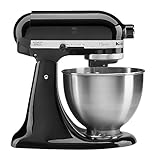
The Classic Series K45SS is the smaller, lighter member of the KitchenAid tilt-head family: a 4.5-quart bowl, a 275-watt motor, 10 speeds, and the same coated flat beater, dough hook, and wire whip setup, finished in Onyx Black. It exists for the baker whose batches are consistently small — a single cake, a dozen muffins, one loaf of bread, a pint of cream — and who values the brand’s build quality and parts support more than maximum capacity.
Key specs
- Bowl capacity: 4.5 quarts, stainless steel
- Motor: 275 watts, direct-drive with metal gearing
- Speeds: 10
- Mixing action: planetary
- Attachment hub: front power hub for the brand’s optional attachments
- Included tools: coated flat beater, coated dough hook, wire whip
- Design: tilt-head, Onyx Black
Where it earns its place
The argument for the Classic over a cheaper 6-quart mixer is not capacity — it loses that comparison outright. It is that the Classic is a properly engineered small machine rather than a large machine built cheaply. Planetary mixing, metal gearing, ten speeds with a real slow start, and access to the same attachment ecosystem as the Artisan all carry over. For a baker making one cake a week and a loaf on Sundays, that is more than enough machine, and it will likely outlast two budget mixers bought in the same period.
The 4.5-quart bowl has a real advantage too: smaller bowls mix small quantities better. Whipping two egg whites or creaming a quarter-cup of butter in a 6.5-quart bowl is awkward because the beater cannot reach the ingredients properly. In a 4.5-quart bowl, small batches behave. If your baking skews toward small, frequent, precise work rather than big weekend batches, this is a meaningful benefit rather than a compromise.
Bread capacity is the clear limit. The 275-watt motor and 4.5-quart bowl comfortably handle a single loaf or a batch of rolls; pushing toward two large loaves of stiff dough will work the motor harder than is comfortable, and you should expect to keep kneading times shorter and hydration higher.
Pros
- Planetary mixing and metal gearing in a compact, lighter body
- Same attachment hub as the larger KitchenAid tilt-heads
- Smaller bowl performs better on small batches than a big bowl does
- Strong replacement-part and service availability
Cons
- 4.5-quart bowl is the smallest premium-tier capacity here
- 275 watts limits it to light and moderate dough work
- Costs premium money for a capacity that mid-range mixers beat on paper
- Coated tools can chip with repeated dishwasher cycles
How it compares
The obvious internal comparison is the KitchenAid Artisan. The Artisan gives you an extra half-quart, an extra 50 watts, and a bowl with a handle for a higher price; the Classic gives you the same engineering in a lighter, smaller package. If counter space or lifting weight is the constraint, the Classic is genuinely the better fit rather than a downgrade. Against the Amazon Basics 5.3-quart, the Classic loses on paper — smaller bowl, lower wattage — but wins on mixing action, gear materials, and long-term parts support. That is the whole premium-versus-budget argument in one sentence, and which side you land on depends on whether you are buying a mixer for three years or ten.
6. NutriMill Artiste Kitchen Electric Stand Mixer 500 Watt 6.5 Quart – Best for Whole-Grain and Hearth Bread Baking

NutriMill is a brand best known for grain mills, and the Artiste reflects that heritage: a 6.5-quart bowl, a 500-watt motor, a dough hook, and wire whips, in a black-trim finish. It is built for bakers who start with grain rather than with a bag of flour — people who mill their own wheat and then need a mixer with the bowl volume and the low-speed grunt to turn dense whole-grain dough into a loaf.
Key specs
- Bowl capacity: 6.5 quarts
- Motor: 500 watts
- Included tools: dough hook and wire whips
- Finish: black trim
- Motor class: high-torque, bread-oriented
Where it earns its place
Whole-grain dough is harder on a mixer than white-flour dough. Bran particles interrupt gluten development, the dough is heavier and stickier, and it demands more sustained torque at low speed than a typical cake batter ever will. A mixer designed with grain baking in mind prioritises exactly that: a broad, powerful low-speed range rather than a long ladder of high-speed settings you will rarely use.
The 6.5-quart bowl matters here for a practical reason. Whole-grain doughs are often mixed in larger batches because they are baked more frequently by the people who make them, and a big bowl means one session produces several loaves. The included dough hook is the tool you will use most, and the wire whips cover the meringue, whipped cream, and cake side of things when you switch back to lighter work.
Where this mixer differs from the KitchenAid platform is in breadth rather than depth. It is a strong bread machine; it is not a hub for a dozen optional attachments. If your baking is centred on loaves and your milling happens in the same corner of the kitchen, that focus is a feature. If you want one machine to also roll pasta and grind meat, the Artisan’s ecosystem is the better fit.
Pros
- 500-watt motor tuned for sustained low-speed dough work
- 6.5-quart bowl suits multi-loaf whole-grain batches
- Dough hook and wire whips included as standard
- Natural pairing with the brand’s grain-milling heritage
Cons
- Premium price for a machine with a narrower attachment ecosystem than KitchenAid
- Less widely distributed, so replacement parts and service take more effort to source
- Large footprint relative to a 5-quart tilt-head
- Overkill if your baking is mostly cakes and cookies
How it compares
Against the Aucma 6.5-QT 660W, the specifications look similar — same bowl size, comparable motor class — but the intent differs. The Aucma is a general-purpose mid-range mixer that happens to have a big bowl; the Artiste is a bread-first machine at a premium price. If you are milling your own flour and baking sourdough several times a week, the Artiste’s focus is worth paying for. If you bake a mix of cakes, cookies, and the occasional loaf, the Aucma or the KitchenAid Artisan will serve you better for less or similar money. Against the Artisan specifically, it comes down to whether you want a bread specialist or a generalist with the best attachment ecosystem in the category.
7. Camic 4.2QT + 5.3QT Two-Bowl Electric Mixer – Best for Bakers Who Want Two Bowl Sizes

Camic’s mixer takes an unusual approach: instead of one bowl, it ships with two — a 4.2-quart and a 5.3-quart — in a black tilt-head electric mixer with a 10-speed control. The idea is straightforward and genuinely useful. Small batches behave better in a small bowl; large batches need the bigger one; and having both means you can cream butter in the 4.2-quart and then switch to the 5.3-quart for the batter without washing up in between.
Key specs
- Bowl capacities: 4.2 quarts and 5.3 quarts, both included
- Speeds: 10
- Form factor: tilt-head electric mixer, black
- Motor class: mid-tier, matched to the 5-quart category
- Accessories: standard mixing tools for the category
Where it earns its place
Two bowls is a more practical feature than it first appears. Most bakers eventually buy a second bowl anyway, because the workflow of a cake plus frosting or a bread dough plus a sponge runs into the same bowl at the same time. Buying a mixer that includes both sizes up front removes that purchase and the guesswork about which size you need. The 4.2-quart bowl also solves the small-batch problem: whipping a small quantity of cream in a big bowl is frustrating because the whisk cannot engage the liquid properly.
Ten speeds gives you a useful range for both light and heavy work, and the tilt-head format keeps the machine easy to load and scrape down. For cakes, cookies, frosting, meringue, and moderate bread dough, this covers the standard home baking repertoire without fuss.
The trade-offs are the usual mid-range ones: no expandable power hub, mid-tier materials inside the transmission, and a shorter expected service life than a premium machine under heavy weekly use. The two-bowl bundle is the differentiator, and if that matches how you actually bake, it is a real advantage rather than a marketing line.
Pros
- Two bowl sizes included, covering small and medium batches without extra purchases
- 10 speeds gives fine control across light and heavy mixing
- Smaller bowl performs noticeably better on small quantities
- Mid-range price for a package that includes what other brands sell separately
Cons
- No front power hub for pasta, grinding, or spiralizing attachments
- Mid-tier gear materials; not built for years of daily stiff dough
- Two bowls need two storage spots
- Limited replacement-part availability compared with established brands
How it compares
Against the Amazon Basics 5.3-quart tilt-head, the Camic wins on flexibility: the Amazon Basics gives you one 5.3-quart bowl, 12 speeds, and a 350-watt motor, while the Camic gives you two bowls and 10 speeds at a similar tier. If you frequently make small batches, the second small bowl is worth more than two extra speed settings. Against the Aucma 6.5-QT, the Camic gives up capacity — the Aucma’s single bowl is larger than either Camic bowl — but gains the small-batch capability the Aucma cannot offer. For a baker who alternates between a pint of whipped cream and a full cake, the Camic’s two-bowl design is the more thoughtful package.
8. VEVOR Commercial Food Mixer 15Qt – Best for High-Volume Home Bakeries

The VEVOR 15-quart commercial mixer is a different category of machine from everything else in this roundup. A 15-quart bowl, a 550-watt motor, and three adjustable speeds in a commercial-style chassis put it in the same class as equipment used in small bakeries and restaurant kitchens. It is not a kitchen appliance in the domestic sense — it is a piece of production equipment that happens to fit in a large home kitchen.
Key specs
- Bowl capacity: 15 quarts (roughly 14 liters)
- Motor: 550 watts
- Speeds: 3 adjustable speeds
- Build: commercial-style chassis designed for continuous production use
- Accessories: commercial mixers in this class typically ship with a dough hook, flat beater, and wire whip
Where it earns its place
Capacity is the entire point. A 15-quart bowl holds roughly three times what a 5-quart home mixer does, which turns a six-loaf bake into a single mixing session and makes it possible to produce at a volume that a home tilt-head simply cannot reach. For anyone selling at a farmers’ market, supplying a café, or baking for a large household, that difference is not convenience — it is the difference between the work being viable and not.
Three speeds sounds sparse next to a 10-speed home mixer, and it is. But commercial mixers are designed around the idea that you need a slow speed for dough, a medium speed for creaming and general mixing, and a fast speed for whipping, and that anything between those is a luxury. What matters more is that the drive is built to run at low speed under load for extended periods without overheating, which is precisely what a home mixer is not designed to do.
The real cost is spatial and physical. A machine this size occupies a substantial footprint, is heavy enough that moving it is a two-person job, and needs meaningful vertical clearance. It is also utilitarian in appearance — this is equipment, not decor. If your kitchen cannot dedicate permanent space to it, it will become a nuisance rather than an asset.
Pros
- 15-quart bowl handles production-level batch sizes
- Built for sustained low-speed dough work without overheating
- 550-watt motor with a commercial-duty drive
- Three simple speeds with no fiddly settings to misconfigure
Cons
- Very large footprint and substantial weight; requires dedicated space
- Only three speeds — no fine control for delicate mixing
- No home attachment ecosystem for pasta, grinding, or spiralizing
- Premium price and clearly over-specified for ordinary household baking
How it compares
Against the KitchenAid Artisan, this is not really a comparison — it is a fork in the road. The Artisan is a versatile 5-quart home machine with an attachment hub and a decade of parts support; the VEVOR is a single-purpose volume tool. If you bake two loaves a week, the Artisan is correct and the VEVOR is absurd. If you bake twenty loaves a week to sell, the Artisan cannot keep up and the VEVOR is the only sensible answer in this list. The closest alternative here is the NutriMill Artiste, which shares the bread-first intent but at a fraction of the capacity. Choose the Artiste if you want bread focus in a home-sized machine; choose the VEVOR if batch size is the constraint you are actually trying to solve.
9. OLIXIS 6.3 Qt Stand Mixer – Best Budget Pick for Big-Bowl Cake and Cookie Baking
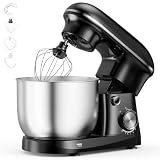
OLIXIS offers a 6.3-quart bowl and a 10-speed tilt-head control at the budget tier, which is an unusual combination — most budget mixers top out around 4 to 5 quarts. The pitch is simple: if you want a big bowl for cakes, cookies, and frosting without paying mid-range money, this is one of the few options that delivers it.
Key specs
- Bowl capacity: 6.3 quarts
- Speeds: 10
- Form factor: tilt-head electric mixer
- Motor class: budget-tier, sized for batters and light dough
- Accessories: standard mixing tools for the category
Where it earns its place
The value proposition is bowl volume per dollar. A 6.3-quart bowl means you can cream a large quantity of butter and sugar, mix a double batch of cookie dough, or build a full-size cake batter without the mixture climbing out. Ten speeds gives you more control than the six-speed budget mixers, and the tilt-head format keeps loading and scraping straightforward.
For cakes, cookies, quick breads, frostings, and meringue, this is a perfectly capable machine. It is also a sensible choice for someone who bakes in larger quantities but does not want to spend mid-range or premium money on a mixer they will use a few times a month rather than weekly.
The honest limitation is dough. A budget-tier motor in a 6.3-quart bowl is a mismatch for stiff bread dough: the bowl invites you to mix a large batch, but the motor is not built for sustained low-speed kneading at that volume. If bread is a significant part of your baking, spend the extra on the Aucma or the CEBORY, both of which pair a 6.5-quart bowl with a 660-watt motor. If your baking is predominantly cakes and cookies, the OLIXIS gives you the bowl size that matters at the price you want to pay.
Pros
- 6.3-quart bowl at a budget price — the largest capacity in the budget tier here
- 10 speeds offers more control than six-speed budget alternatives
- Tilt-head design is easy to load, scrape, and clean
- Good fit for cakes, cookies, and frosting in larger quantities
Cons
- Budget-tier motor is not suited to sustained stiff bread dough
- Build materials are entry-level; expect a shorter service life
- No expandable power hub
- Large bowl with a modest motor can encourage overloading
How it compares
Against the Amazon Basics 5.3-quart, the OLIXIS wins on bowl size — 6.3 quarts versus 5.3 — while the Amazon Basics counters with a 350-watt motor and 12 speeds. If you want maximum bowl volume for minimum money, the OLIXIS is the pick. If you want the most balanced budget machine, the Amazon Basics is the safer bet, because its motor and bowl are better matched to each other. Against the Aucma 6.5-QT, the OLIXIS gives up the 660-watt motor and a small amount of capacity, but costs less. The decision comes down to whether you knead bread: if yes, pay for the Aucma; if no, the OLIXIS is the more efficient use of money.
10. Amazon Basics Tilt-Head Stand Mixer, 5.3Qt, 350W, 12 Speeds – Best Budget All-Rounder

The Amazon Basics tilt-head
Related Reviews & Guides


Zucchini Bar Recipe: Moist, Easy, and Frosted
Best Heavy-Duty Meat Grinders for Raw Dog Food