Last Updated: October 8, 2026
- Best 2-slice toasters at a glance
- Our picks by situation
- Best overall: Breville Bit More 2-Slice
- Best for thick bread and longevity: Dualit NewGen 2-Slot
- Best compact budget option: Cuisinart CPT-160
- Best design-led choice: Smeg TSF01
- Slot width matters more than the number on the box
- How to get more even browning
- Crumb trays, cleaning, and what wears first
- Final verdict
The best 2 slice toasters for most kitchens are the Breville Bit More for convenient, even everyday toasting, the Dualit NewGen 2-Slot for thick bread and long-term repairability, and the Cuisinart CPT-160 for a compact, lower-cost countertop option.
The right choice depends less on headline wattage than on four practical details: whether the slots accept your bread, how evenly the toaster browns both sides, whether the controls are easy to use from either hand, and how quickly crumbs can be removed. A toaster that fits standard sandwich bread but struggles with sourdough, bagels, or homemade slices may be a poor match despite a low price.
As an Amazon Associate we earn from qualifying purchases at no extra cost to you.
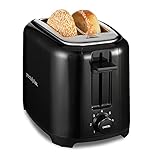


Best 2-slice toasters at a glance
| Toaster | Best for | Slot width | Approx. dimensions | Power | Typical price range |
|---|---|---|---|---|---|
| Breville Bit More 2-Slice | Convenient, consistent everyday toast | About 1.5 in / 3.8 cm | 11.3 × 6.5 × 8.3 in | 900–930 W | $70–$100 |
| Dualit NewGen 2-Slot | Thick bread, durability, repairability | About 1.1 in / 2.8 cm | 10.5 × 7.5 × 9 in | 1,200 W | $250–$350 |
| Smeg 2-Slice Toaster TSF01 | Design-led kitchens and broad controls | About 1.1 in / 2.8 cm | 12.2 × 6.5 × 8.2 in | 950 W | $180–$230 |
| Cuisinart CPT-160 | Budget buyers and smaller counters | About 1.5 in / 3.8 cm | 10.8 × 6.7 × 7.2 in | 900 W | $35–$60 |
Dimensions and slot measurements are approximate manufacturer specifications and can vary slightly by regional version. Allow additional clearance above the toaster for lifting bread and behind it for the power cord.
Our picks by situation
| Your situation | Best fit | Why | Compromise |
|---|---|---|---|
| You toast daily and want simple repeatability | Breville Bit More | Countdown-style progress, lift-and-look operation, and dedicated frozen and bagel settings | More electronics than a basic toaster |
| You use thick homemade bread or want a long ownership horizon | Dualit NewGen | Mechanical controls, robust construction, and replaceable elements in many service arrangements | Expensive and less forgiving of unevenly sized slices |
| You have a narrow counter and a firm budget | Cuisinart CPT-160 | Shorter footprint, wide slots, and separate browning controls | Less refined lifting and browning can vary at extreme settings |
| Appearance matters as much as function | Smeg TSF01 | Compact two-slot layout, clear rotary control, and strong finish options | Premium cost does not guarantee better toast than less expensive models |
Best overall: Breville Bit More 2-Slice
The Breville Bit More is the easiest recommendation for ordinary sandwich bread, English muffins, and occasional bagels. Its wide slots accommodate thicker slices than many basic two-slot models, while the “A Bit More” function adds a short finishing cycle instead of forcing you to restart the full program.
Its lift-and-look feature is particularly useful when changing bread brands or adjusting from white bread to dense whole-grain slices. You can raise the carriage and inspect the color without cancelling the cycle. That small control advantage helps prevent the most common toaster mistake: repeatedly adding time because the first setting is unfamiliar.
The controls are friendly for left- or right-handed use because the main lever and buttons are on the front-facing control panel rather than requiring access to a side-mounted dial. The drawback is ownership complexity. Electronic buttons and motorized controls are convenient, but a mechanical toaster is generally easier to diagnose if it develops a fault.
Best for thick bread and longevity: Dualit NewGen 2-Slot
The Dualit NewGen is the specialist choice for people who regularly toast substantial slices, crumpets, or bagels and value serviceability. Its slots are relatively wide and deep, and the selector lets you heat one or both slots. The mechanical timer gives direct control, while the high power rating helps it recover between batches.
Its browning pattern is different from a fully automatic toaster. Because it uses a mechanical timer and a particular heating-element layout, you may need to rotate irregular homemade slices or adjust the timer as the toaster warms. That is not a defect so much as the trade-off for a repair-oriented design.
The NewGen is also taller and heavier than budget models. Measure the space between your counter and cabinets, especially if you plan to lift bread out with tongs. Never insert metal utensils into an energized toaster; unplug it and let it cool before clearing a stuck slice.
Best compact budget option: Cuisinart CPT-160
The Cuisinart CPT-160 is a sensible choice when the toaster will live in a small apartment kitchen or be put away after use. Its approximately 1.5-inch slots suit standard bread and many thicker bakery slices, and the two independently adjustable browning controls are useful when two people prefer different levels.
It offers the essential functions without taking up as much vertical space as some premium models. Expect fewer refinements: the carriage feel is more utilitarian, and very light or very dense slices may not brown with identical intensity. For occasional toast, those limitations are usually acceptable; for several batches every morning, a better-insulated and more consistent model may justify its higher price.
Best design-led choice: Smeg TSF01
The Smeg TSF01 combines a broad browning dial with dedicated settings for reheating, defrosting, and bagels. It is a good match for a visible countertop where the appliance needs to look intentional rather than purely functional. The slot width handles ordinary sandwich bread and moderately thick slices.
Do not select it solely for its appearance. The long body can occupy more horizontal space than expected, and premium finishes can make fingerprints and crumbs more noticeable. Its performance is most useful when your priorities are attractive design, familiar controls, and reliable everyday browning rather than maximum bread capacity.
Slot width matters more than the number on the box
“Wide slot” is not a universal measurement. A 1.5-inch slot can accept thick packaged bread, but the usable opening may be reduced by internal guides. Slot depth matters too: a wide but shallow slot can leave the top of a tall slice pale.
- Standard sliced bread: Slots around 1.1 inches are usually adequate.
- Thick sourdough or homemade bread: Look for approximately 1.3–1.5 inches and flexible centering guides.
- Bagels: A dedicated bagel setting should toast the cut side while warming the outer side.
- Long slices: A two-slot toaster may leave exposed ends pale; consider a long-slot model instead.
- Small slices: High-lift carriage travel is more important than slot width because it reduces the need to reach into the slot.
For a left-handed user, front-mounted controls are usually the least awkward arrangement. A side dial is not unusable, but it can force you to reach across the hot appliance or position the toaster at an angle. Whichever model you choose, keep the cord routed away from the control side and leave enough room to remove the crumb tray without moving the toaster.
How to get more even browning
- Start at a middle setting. Test one slice before making a full batch. Dense bread often needs more time, while sweet bread can brown faster because of its sugar content.
- Use the same orientation. Put similarly shaped slices into the same slots. A thick crust on one side can change how close the bread sits to the heating element.
- Allow recovery time. After a batch, wait briefly if the toaster is visibly hot. Back-to-back cycles can produce darker results as the elements retain heat.
- Use the bagel setting correctly. Place the cut side toward the marked heating side. If the model has no directional marking, consult its manual rather than guessing.
- Adjust in small increments. One additional minute can be a large change at higher settings. Use “a little more” or a short second cycle when available.
Crumb trays, cleaning, and what wears first
A removable crumb tray is more valuable than a glossy exterior. Empty it at least weekly with frequent use, and more often if you toast seeded or flaky bread. Crumbs left near heating elements can smoke and create unpleasant odors. Unplug the toaster, let it cool completely, slide out the tray, and brush loose crumbs into a bin. Do not immerse the toaster or pour liquid into its slots.
The first parts to show wear are commonly the carriage mechanism, browning control, heating elements, and crumb-tray fit. Springs can lose tension; electronic buttons can become intermittent; repeated use can discolor exposed metal. A toaster with replaceable elements or an established repair route can cost more initially but reduce waste over several years.
A simple ownership calculation puts the premium in context. If a $300 toaster lasts eight years and is used twice daily, its purchase cost is about 5 cents per use: $300 divided by 5,840 uses. A $50 toaster lasting three years at the same frequency costs about 2 cents per use. The premium is therefore about 3 cents per use before energy and repair costs. Choose the premium model for its capacity, serviceability, or controls—not because a higher price automatically means browner toast.
Final verdict
Choose the Breville Bit More for the best balance of convenient controls, wide slots, and repeatable everyday results. Choose the Dualit NewGen 2-Slot if thick bread and repairability matter more than price or footprint. Choose the Cuisinart CPT-160 for a compact, affordable appliance, and the Smeg TSF01 when countertop design is a major part of the decision. Before buying, measure your available counter space, compare the actual slot opening with your thickest slice, and check that the crumb tray can be removed without turning the toaster sideways.
Related Reviews & Guides


Best Bread Machines for Homemade Loaves
Best Half Sheet Pans for Everyday Baking