Last Updated: September 19, 2026
- Top Pick: Pulsar Gaming Gears X3 LHD Crazylight Gaming Mouse, Mini, Uyuni White
- Best Value: Pulsar Gaming Gears X3 LHD Crazylight Gaming Mouse, Mini, Jet Black
- Premium Choice: Pulsar Gaming Gears X3 Wireless Gaming Mouse, Ultra Lightweight (1.94 oz/55g), Hybrid Ergonomic, Optical Switch, 32000 DPI, (Left-Handed, Medium, White) (Renewed)
The Short Answer
Finding the right left handed gaming mouse dimensions for palm grip depends directly on your hand’s physical measurements from wrist crease to fingertip. For a full palm grip—where your entire palm rests against the top shell with zero dead space—the mouse length should equal roughly 60% to 65% of your total hand length. For an average adult left-handed player with a hand length between 6.8 and 7.5 inches (17.3 to 19.0 cm), the ideal mouse dimensions are 4.80 inches (12.2 cm) long, 2.62 inches (6.65 cm) wide, and 1.57 inches (4.0 cm) high. Small hands under 6.7 inches (17 cm) require mini dedicated shells around 4.55 inches (11.56 cm) long, while large hands over 7.5 inches need chassis lengths exceeding 5.0 inches (12.7 cm) with a high rear hump above 1.6 inches (4.1 cm).
Standard Sizes
Dedicated left-handed gaming mice and left-friendly ambidextrous designs fall into three core size categories. Because palm grip relies heavily on rear height (the chassis hump) to support the palm arch, pay special attention to the height column alongside length and width.
As an Amazon Associate we earn from qualifying purchases at no extra cost to you. Product prices and availability are accurate as of the date shown and are subject to change.


| Size Category | Hand Length Range | Mouse Dimensions (L x W x H) | Weight Range | Price Range | Example Models |
|---|---|---|---|---|---|
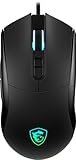
| Small / Mini Left-Handed | Under 6.7 in (Under 17.0 cm) | 4.55″ x 2.44″ x 1.48″ (11.56 x 6.20 x 3.76 cm) | 1.70 – 1.94 oz (48 – 55g) | $120 – $135 | Pulsar X3 LHD Crazylight Mini ($129.95) |
| Medium Left-Handed Ergonomic | 6.8 in – 7.5 in (17.3 – 19.0 cm) | 4.80″ x 2.62″ x 1.57″ (12.20 x 6.65 x 4.00 cm) | 1.94 – 2.40 oz (55 – 68g) | $65 – $130 | Pulsar X3 LHD Wireless Medium ($69.00 – $129.95) |
| Entry Ambidextrous / Standard | 6.5 in – 7.3 in (16.5 – 18.5 cm) | 4.90″ x 2.56″ x 1.50″ (12.45 x 6.50 x 3.81 cm) | 2.80 – 3.50 oz (79 – 99g) | $25 – $35 | MSI Forge GM320 ($29.99) |
| Large Left-Handed Shell | Over 7.5 in (Over 19.0 cm) | 5.05″ x 2.75″ x 1.65″ (12.83 x 6.98 x 4.19 cm) | 2.20 – 2.90 oz (62 – 82g) | $80 – $140 | Custom Left Ergonomic Shells |
How to Measure Your Space
Selecting the right size requires measuring both your dominant left hand and your physical gaming desk footprint. As gaming gear engineering continues to refine ultra-lightweight frames in 2026, getting precise measurements ensures your hand sits in an anatomically neutral position without thumb or wrist drag.
- Measure Hand Length: Open your left hand flat with fingers extended together. Measure in inches or centimeters from the first major wrist crease up to the tip of your middle finger.
- Measure Hand Width: Keep your hand flat and measure straight across the palm, starting from the outer base of your pinky knuckle to the outer edge of your thumb knuckle.
- Calculate Your Mouse Length Target: Multiply your overall hand length by 0.62. For instance, a 7.2-inch hand (18.3 cm) multiplied by 0.62 yields a target mouse length of roughly 4.46 to 4.75 inches (11.3 to 12.0 cm).
- Verify Hump Placement and Height: Measure the space beneath your palm when making a relaxed fist. A true palm grip requires a top shell height of at least 1.50 inches (3.8 cm). If the peak height sits too far forward or stays under 1.4 inches, your palm will collapse into a claw or hybrid grip.
- Check Desk Surface Clearance: Ensure your desk space accommodates both the mouse and your sweeping radius. Low-DPI arm gamers need a pad clearing at least 17.7 x 15.7 inches (45 x 40 cm), whereas high-DPI wrist players need a minimum clear zone of 12 x 10 inches (30 x 25 cm).
By Room or Use Case
FPS and Fast-Paced Competitive Gaming
First-person shooter (FPS) players using a palm grip need a blend of high rear-hump palm support and lightweight construction to perform rapid flick shots. Ultra-lightweight models weighing between 1.70 oz and 1.94 oz (48g to 55g) excel here. The Pulsar Gaming Gears X3 LHD Crazylight Mini (available in Uyuni White or Jet Black for $129.95) provides dedicated left-handed ergonomics with a compact 4.55-inch length and 1.48-inch height. Its high rear curve anchors the base of the left palm securely while allowing high-precision sensor tracking up to 32,000 DPI without tiring the forearm during extended competitive matches.
MOBA, MMO, and Long-Session Productivity
For strategic games and long work sessions, comfort supersedes raw flick speed. A medium dedicated left-handed mouse, such as the Pulsar X3 Wireless LHD Medium (available renewed around $69.00 or new up to $129.95), features a 4.80-inch chassis that gives medium-to-large palms full structural support. The elevated arch prevents the metacarpal bones from sagging onto the mouse pad. Alternatively, budget-conscious lefties can opt for symmetrical ambidextrous frames like the MSI Forge GM320 ($29.99). Featuring a 4.90-inch length, 12,800 DPI sensor, micro switches rated for 20M+ clicks, and full RGB lighting, it delivers durable palm support across multi-hour gaming and work sessions.
Compact Desks and Travel Workstations
If your gaming desk space is tight—such as a dorm desk or small home office nook under 36 inches wide—mouse footprint becomes critical. Mini left-handed mice with a total footprint under 4.6 inches in length and 2.45 inches in width minimize physical contact with keyboards. Choosing a wireless left-handed mouse eliminates cable drag entirely, freeing up valuable space on compact mouse pads measuring under 11 x 9 inches.
Common Sizing Mistakes
The most common error left-handed gamers make is buying standard ambidextrous mice without checking button placement or shell contour. True ergonomic left-handed mice (LHD) curve inward on the right side to cradle the left thumb, whereas ambidextrous mice feature flat side walls that offer less thumb support during a heavy palm grip.
Another mistake is ignoring weight distribution. A palm grip mouse that is too heavy (above 3.5 oz / 100g) can strain the left wrist during lift-offs, while a mouse that is too short forces your fingers to overhang the main clicks, forcing your hand into an unintended fingertip or claw position. Always ensure the mouse button length allows your index and middle fingers to rest flat without curling.
FAQ
What hand size is best suited for a palm grip gaming mouse?
Hands measuring between 6.5 inches (16.5 cm) and 7.8 inches (19.8 cm) from wrist crease to middle fingertip are ideal for palm grip gaming mice. Medium hands (6.8 to 7.5 inches) fit standardized LHD gaming shells, while smaller hands need mini variants under 4.6 inches in length to avoid stretching the hand unnaturally.
Is an ambidextrous mouse good enough for a left-handed palm grip?
An ambidextrous mouse works well for palm grip if its hump is high enough (at least 1.50 inches) and it features side thumb buttons accessible by the left thumb. However, dedicated left-handed ergonomic (LHD) mice provide superior palm comfort because the chassis curves outward to support the base of the left thumb and palm muscle.
How heavy should a left-handed palm grip mouse be?
For competitive gaming, the ideal weight ranges from 1.70 oz to 2.12 oz (48g to 60g). Ultra-lightweight mice reduce inertia and wrist fatigue during rapid swipes. For casual gaming or office productivity, weights up to 3.5 oz (100g) remain comfortable for standard palm grip usage.
What mouse dimensions fit small vs. large left-handed palms?
Small palms (under 6.7 inches) fit best on mice measuring roughly 4.55″ L x 2.44″ W x 1.48″ H (11.56 x 6.20 x 3.76 cm). Large palms (over 7.5 inches) require mice measuring at least 5.00″ L x 2.70″ W x 1.60″ H (12.70 x 6.85 x 4.06 cm) to ensure full contact without dragging fingers across the mouse pad.
Ready to decide? Our #1 pick for 2026 is the Small / Mini Left-Handed.
Live price & availability on Amazon.
Related Reviews & Guides

8 Best Left Handed Computer Mice: Ergonomic Top Picks
8 Best Left Handed Golf Bags: Carry and Cart Picks