Last Updated: September 19, 2026
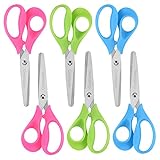
- Top Pick: Asdirne Left Kids Scissors, Safety Children Scissors with Blunt Tip Stainless Steel Blades and Soft Grip, Great for Home and School, Assorted Color, 13.5cm, 3 Pack
- Best Value: Fiskars 5" SoftGrip Kids Left-Handed Pointed-Tip Scissors, Ages 4-7, Blue
- Premium Choice: OneName Left-Handed Kids Scissors,5" Lefty Scissors for School Kids,6 Pack
Finding the right size left handed scissors for children is essential for developing proper fine motor skills, reducing hand fatigue, and preventing frustration during school and craft projects. Unlike right-handed children, young lefties face unique ergonomic challenges when cutting paper, cardstock, or fabric. When you choose the proper size and true left-handed blade orientation, cutting becomes intuitive, safe, and clean.
The Short Answer
When selecting scissor sizes for young children, the ideal overall length corresponds directly to the child’s age group and palm width:
As an Amazon Associate we earn from qualifying purchases at no extra cost to you. Product prices and availability are accurate as of the date shown and are subject to change.



- Preschool & Kindergarten (Ages 3–4): 4.0-inch to 4.5-inch (10.1 cm to 11.4 cm) scissors with blunt safety tips and small round finger loops.
- Early Elementary (Ages 4–7): 5.0-inch (12.7 cm to 13.5 cm) scissors with blunt or semi-pointed tips and ergonomic soft-grip handles.
- Late Elementary & Middle School (Ages 8–12): 5.5-inch to 6.0-inch (14.0 cm to 15.2 cm) scissors with pointed tips for detailed cutting tasks.
In addition to length, always verify that the blades themselves are inverted—meaning the upper blade sits to the left side when held, giving your child an unobstructed view of the cutting line. True left-handed scissors differ significantly from “ambidextrous” models, which only modify the handle shape while keeping right-handed blade geometry.
Standard Sizes
Children’s scissors are standardized across major school supply manufacturers using total overall tool length, blade length, and tip profile. Use this reference guide updated for 2026 classroom standards to match your child’s current growth stage:
| Age Group | Total Length (Inches) | Total Length (cm) | Blade Cutting Edge | Recommended Tip Type | Average Price Range |
|---|---|---|---|---|---|
| Toddler / Preschool (Ages 3–4) | 4.0 in – 4.5 in | 10.2 cm – 11.4 cm | 1.5 in (3.8 cm) | Blunt Plastic / Safety Tip | $2.50 – $4.50 per unit |
| Early Elementary (Ages 4–7) | 5.0 in – 5.3 in | 12.7 cm – 13.5 cm | 2.0 in (5.1 cm) | Blunt or Pointed Steel Tip | $3.50 – $7.00 per unit |
| Upper Elementary (Ages 8–11) | 5.5 in – 5.75 in | 14.0 cm – 14.6 cm | 2.5 in (6.4 cm) | Pointed Precision Tip | $4.50 – $8.50 per unit |
| Tweens & Middle School (Ages 12+) | 6.0 in – 6.5 in | 15.2 cm – 16.5 cm | 3.0 in (7.6 cm) | Pointed Precision Tip | $6.00 – $11.00 per unit |
Single pairs, such as a Fiskars 5-inch SoftGrip left-handed pair, typically cost between $4.50 and $5.50. Bulk classroom bundles (such as 3-packs or 6-packs from brands like LIVINGO, Asdirne, or OneName) average $7.00 to $10.00 total, bringing the individual cost down to roughly $1.50 to $3.30 per pair.
How to Measure Your Space
To ensure proper hand comfort, physical safety, and organized storage at your home study desk or craft station, follow these four steps to measure your child’s hand size and workstation clearance:
- Measure Palm Span and Finger Length: Have your child place their left hand flat on a piece of paper. Measure from the base of the palm (wrist crease) to the tip of the middle finger. If the hand length is under 4.5 inches (11.4 cm), stick with 4.5-inch to 5.0-inch scissors. If hand length exceeds 5.5 inches (14.0 cm), transition to a 5.5-inch or 6.0-inch tool.
- Check Loop Opening Outer Dimensions: Measure the thumb and index finger width. Standard 5-inch kids’ scissor thumb loops measure approximately 0.9 inches by 1.1 inches (2.3 cm x 2.8 cm). Multi-finger bottom loops measure approximately 1.5 inches to 1.8 inches (3.8 cm x 4.6 cm), allowing two or three fingers to slide in comfortably without slipping or binding.
- Account for Desk Drawer Tray Clearances: Standard modular drawer organizers and supply trays in kids’ study desks typically feature compartments measuring 6.5 inches to 8.0 inches (16.5 cm to 20.3 cm) long by 2.0 inches (5.1 cm) wide. A 5-inch pair of left-handed scissors fits easily inside standard trays, but 6-inch models with oversized soft-grip loops require a minimum compartment depth of 0.75 inches (1.9 cm).
- Verify Pencil Case & Craft Caddy Depth: Hard-shell school pencil boxes measure 8.2 inches long by 5.5 inches wide by 2.2 inches deep (20.8 cm x 14.0 cm x 5.6 cm). Multiple 5-inch left-handed pairs fit stacked, but ensure pointed tips are stored in protective sheaths or blade covers to avoid scratching drawer bottoms or vinyl craft mats.
By Room or Use Case
Preschool & Early Learning Activity Corners
For children aged 3 to 5 working at low activity tables or sensory play stations, small 4.5-inch to 5.0-inch (11.4 cm to 12.7 cm) blunt-tip left-handed scissors are mandatory. Safety tips prevent accidental skin punctures while kids learn basic snipping movements on construction paper or play dough. Models weighing under 1.2 ounces (34 grams) prevent thumb strain during early skill building.
Elementary School Homework Desks
A standard 5.0-inch (12.7 cm) or 5.3-inch (13.5 cm) left-handed pair with stainless steel blades (such as 13.5 cm Asdirne or 5-inch Fiskars SoftGrip) provides the best balance for general classwork. These fit seamlessly into standard pencil boxes and accommodate cutting paper, poster board, string, and tape. Look for soft molded rubber handle rings that cushion thumb pressure during extended poster-making projects.
Middle School Art & STEM Craft Workstations
By ages 9 to 12, children engage in intricate science projects, card making, and fabric crafts requiring detailed maneuvers. Upgrade to 5.5-inch or 6.0-inch (14.0 cm to 15.2 cm) pointed-tip left-handed scissors with long cutting edges. The extended blade length allows smooth, continuous straight cuts, while pointed blade tips enable clean interior cutout shapes.
Multi-Child Craft Rooms & Classroom Sets
If you maintain a home craft room or organize materials for multiple children, multi-packs (such as 3-pack or 6-pack options from LIVINGO or OneName) are economical. Multi-packs usually feature standard 5.0-inch blunt or pointed models in vivid color combinations (like blue, green, and red), making left-handed tools easy to identify when mixed with right-handed classroom supplies.
Common Sizing Mistakes
- Buying “Ambidextrous” Instead of True Left-Handed: Ambidextrous scissors feature symmetrical handle loops, but the blades remain stacked in a right-handed configuration. When a left-handed child cuts with ambidextrous scissors, the top blade obscures the cutting line, forcing them to twist their wrist awkwardly. True left-handed scissors reverse the blade overlap so the top blade stays on the left.
- Skipping Ahead to Adult 7-Inch Scissors Too Soon: Parents often give young children full-size adult household scissors (7.0 to 8.0 inches) hoping they will “grow into them.” Oversized handles force a child’s hand into an unnatural splay, leading to poor control, jagged cuts, and rapid hand exhaustion.
- Selecting Pointed Tips Before Fine Motor Mastery: Giving pointed-tip scissors to children under 5 or those still developing hand-eye coordination increases safety risks. Stick to rounded, blunt tips until teachers or parents observe steady directional cutting ability.
- Ignoring Handle Loop Weight & Cushioning: Hard molded plastic scissor handles without soft rubber inserts can pinch tender skin during heavy cutting sessions on thick materials. Select soft-grip lined handles weighing under 1.8 ounces (51 grams) for younger children.
FAQ
What is the difference between true left-handed scissors and right-handed scissors?
True left-handed scissors feature reversed blades. When you open the scissors, the blade on the left side rises to the top. This geometry allows left-handed users to see their cutting line clearly and squeeze their thumb and fingers together naturally without forcing the cutting blades apart.
Are 5-inch scissors adequate for a 7-year-old child?
Yes. A 5-inch (12.7 cm) scissor length is the standard recommended size for children aged 4 to 7. It offers an ideal handle loop opening for small hands while providing enough blade length (about 2 inches of cut length) for general school assignments.
How do I know if my child needs blunt-tip or pointed-tip scissors?
Blunt-tip scissors feature rounded ends designed for preschoolers and early elementary students (ages 3 to 6) to reduce puncture hazards. Pointed-tip scissors offer greater detail and precise interior cutting for children aged 6 or older who have demonstrated safe tool handling skills.
How much do quality children’s left-handed scissors cost?
Single pairs of high-quality left-handed kids’ scissors cost between $4.50 and $7.00. Buying multi-packs (such as 3-packs or 6-packs) brings the cost down to between $1.50 and $3.50 per pair, making them very affordable for homes, classrooms, or art studios.
Ready to decide? Our #1 pick for 2026 is the Toddler / Preschool (Ages 3–4).
Live price & availability on Amazon.
Related Reviews & Guides




11 Best Left-Handed Notebooks: Top Picks Reviewed and Compared (2026)

Best Hard Drive Not Showing Up in 2026: Top Picks Compared