Last Updated: September 18, 2026
- Top Pick: WRITECH Fountain Pen Left Handed: Retractable Fine Nib Black Ink Clictek
- Best Value: Speedball C-Series Lettering Pen Set, Left-handed – 1 Penholder w/ 6 Nibs
- Premium Choice: Lerheedi 10 Pcs Morandi Left Handed Gel Pens Left Handed Quick Drying Pens Click Gel Pen Smooth Writing Black Ink 0.5mm for Journaling Writers School Supplies Calligraphy Office Gift Home Work
The Short Answer
For most left-handed writers, a 0.5 mm pen tip is the safest everyday choice. It produces a clear line without laying down as much ink as a broad 0.7 mm or 1.0 mm point, helping reduce smearing for writers whose hand moves across freshly written words.
Choose a 0.38 mm to 0.5 mm tip if you write small, take dense notes, fill out forms, or are a side-writing lefty whose hand rests close to the line. A 0.5 mm to 0.7 mm tip suits larger handwriting, general journaling, and writers who use quick-drying gel or ballpoint ink. Reserve 0.8 mm to 1.0 mm tips for headings, greeting cards, signatures, and relaxed writing on absorbent paper—not fast note-taking on slick paper.
As an Amazon Associate we earn from qualifying purchases at no extra cost to you.


Tip size matters, but ink type and hand position matter just as much. A 0.5 mm quick-drying gel pen can be more lefty-friendly than a 0.38 mm slow-drying liquid-ink pen. For an easy starting point in 2026, look for a 0.5 mm needle-tip gel pen, rollerball with fast-drying ink, or a fine ballpoint.
Standard Sizes
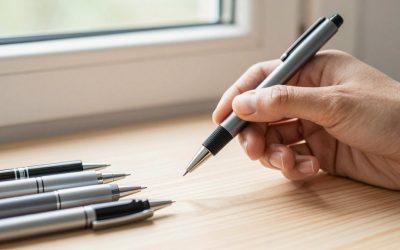
Pen tip measurements refer to the approximate diameter of the writing point, not necessarily the exact width of the line on paper. Ink flow, paper texture, writing pressure, and pen angle all affect the visible mark. Fountain pen nib labels are less standardized than gel and ballpoint sizes: one brand’s fine nib may write like another brand’s extra-fine or medium.
| Tip Size | Diameter in Inches | Diameter in Centimeters | Best For | Left-Handed Considerations |
|---|---|---|---|---|
| 0.38 mm | 0.015 in. | 0.038 cm | Very small handwriting, planners, narrow ruled paper, forms | Uses less ink and gives the smallest smear zone, but may feel scratchy on rough paper or require more pressure. |
| 0.5 mm | 0.020 in. | 0.050 cm | Everyday writing, school notes, lists, work documents | The best all-purpose starting size. It balances legibility, control, and relatively quick drying. |
| 0.7 mm | 0.028 in. | 0.070 cm | Medium to large handwriting, journaling, bold notes | Smoother than fine points, but the wetter, wider line can smear unless the ink dries quickly. |
| 0.8 mm | 0.031 in. | 0.080 cm | Signatures, labels, larger print | Best for underwriters and writers who can keep their hand below the line; less practical for tight note-taking. |
| 1.0 mm | 0.039 in. | 0.100 cm | Headings, cards, bold annotations | Creates a broad, ink-heavy mark. Choose fast-drying ballpoint or low-smear gel ink if using it left-handed. |
| Fountain pen EF nib | Varies by brand | Varies by brand | Small writing and detailed notes | Usually the best fountain-pen starting category for lefties, especially with a dry-writing ink. |
| Fountain pen F nib | Varies by brand | Varies by brand | General writing and correspondence | A good option for many writers, but test ink drying time before using it for rapid notes. |
For a budget-friendly everyday option, 0.5 mm left-handed quick-drying gel pens are commonly sold in multipacks around $8 to $15. The Lerheedi 10-piece 0.5 mm quick-drying gel pen set, for example, is listed at $9.99. For premium gel refills, a box of 12 Pentel EnerGel-X 0.5 mm needle-tip pens is listed at $14.95. Those examples illustrate why 0.5 mm is such a practical category: it is widely available in fast-drying formulations.
How to Measure Your Space
You do not need to measure a pen tip at home, but measuring your writing area and observing your hand position can reveal which size will feel most comfortable. Use a ruler, a sheet of your usual paper, and two or three pen sizes if possible.
- Measure the ruled line height. Standard college-ruled paper has lines about 9/32 inch (0.71 cm) apart, while wide-ruled paper is about 11/32 inch (0.87 cm) apart. Choose 0.38 mm or 0.5 mm for college rule; 0.5 mm or 0.7 mm usually fits wide rule comfortably.
- Check your letter height. Write a normal sentence, then measure the height of lowercase letters such as “a,” “e,” and “n.” If most are under 1/8 inch (0.32 cm) tall, start with 0.38 mm or 0.5 mm. If they are closer to 3/16 inch (0.48 cm) or taller, 0.5 mm or 0.7 mm may look more balanced.
- Mark where your hand rests. Write several lines at your natural speed. If the side of your palm crosses the line immediately after you write it, use a smaller point and fast-drying ink. If your hand stays below the baseline, you can use broader tips more easily.
- Measure your desk clearance. Allow at least 10 inches (25.4 cm) of clear desk depth from the paper’s lower edge to the desk edge. A cramped setup can force a hooked wrist position, making smearing and hand fatigue worse regardless of pen size.
- Test on your actual paper. Smooth coated notebooks, glossy planners, and cheap copy paper can produce different drying times. Write a full paragraph, then drag the side of your hand across it after one second, three seconds, and five seconds. This is not a lab test; it is simply a useful real-world comparison for your own paper and writing speed.
By Room or Use Case
School Desks, Homework, and Exam Notes
A 0.5 mm quick-drying gel pen is the best default for left-handed students. It is fine enough for margins, equations, and compact notes, yet smoother than many ultra-fine points. If you write exceptionally small or need to fit many words into a planner square, move down to 0.38 mm. Avoid 1.0 mm pens for long exams unless you know the ink dries almost instantly.
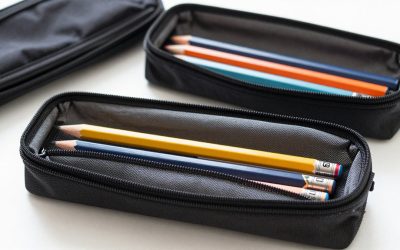
Keep one black and one blue 0.5 mm pen in your pencil case, plus a 0.7 mm pen for headings. A typical retractable gel pen weighs roughly 0.3 to 0.5 ounce (9 to 14 grams), light enough for extended sessions without requiring a heavy grip.
Home Office, Forms, and Everyday Paperwork
For checks, forms, mailing labels, and printed documents, choose a 0.5 mm or 0.7 mm ballpoint or a quick-drying gel pen. Ballpoints generally place less wet ink on the page, which can make them easier for overwriters and sidewriters. A 0.5 mm tip is better for small signature boxes and fine print; 0.7 mm feels smoother for standard forms and larger signatures.
If you frequently write on glossy receipts or coated forms, carry a ballpoint. Gel ink can take longer to set on nonabsorbent surfaces, even when the pen is marketed as quick-drying.
Journaling, Cards, and Personal Correspondence
Use a 0.5 mm or 0.7 mm gel pen for ordinary journals and letters. The 0.7 mm size makes handwriting look more expressive and is often less scratchy than a fine point, but select a fast-drying ink if your hand tracks over your words. For greeting cards and bold decorative writing, 0.8 mm and 1.0 mm tips offer more visual presence.
Fountain pens can be enjoyable for correspondence, but left-handed writers should begin with an extra-fine or fine nib and a dry-writing ink. A left-handed fountain pen design may use a nib shaped or tuned for a pushing motion; the WRITECH retractable fine-nib left-handed fountain pen is one example, listed at $21.99. Still, the paper and ink combination will determine whether it smears.
Calligraphy and Lettering
Calligraphy is different from regular handwriting: nib width is chosen for the letter style and the x-height, not merely for drying speed. Left-handed calligraphers may prefer left-handed oblique or specially cut nibs that make broad strokes more controllable when pushed across the page. A set such as the Speedball C-Series left-handed lettering set, with one holder and six nibs, is listed at $17.99.
For practice, use absorbent marker paper or quality calligraphy paper and leave extra space between lines. Broad nibs can range far beyond 1.0 mm, so give wet lettering time to dry before moving your hand over it.
Common Sizing Mistakes
- Assuming finer always means better. A 0.38 mm tip can reduce ink volume, but it may drag on rough paper and encourage a tight grip. Many lefties write more comfortably with 0.5 mm.
- Choosing by tip size alone. A broad fast-drying ballpoint may smear less than a fine, wet rollerball. Consider ink chemistry and paper finish.
- Buying a medium fountain nib for tiny handwriting. Fountain nib labels vary, and a medium nib can look too broad on college-ruled paper. Start with EF or F for compact writing.
- Ignoring writing posture. Hooked overwriters need faster-drying ink than underwriters because their hand passes over fresh marks more quickly.
- Testing only one word. A pen can feel smooth for a signature yet smear during a full page of notes. Test at your normal speed for at least several lines.
FAQ
Is 0.5 mm or 0.7 mm better for left-handed writers?
For most left-handed writers, 0.5 mm is better as a starting point because it lays down less ink while remaining smooth and readable. Choose 0.7 mm if you have larger handwriting, prefer a softer glide, and use fast-drying ink on absorbent paper.
What is the best pen tip for a left-handed overwriter?
A 0.38 mm or 0.5 mm quick-drying gel pen, fine ballpoint, or extra-fine fountain pen with dry ink is usually the best fit. Overwriters should prioritize drying time because the hand travels directly over the newly written line.
Do left-handed writers need special pens?
Not necessarily. Many left-handed writers do well with standard 0.5 mm quick-drying gel pens or ballpoints. Special left-handed fountain pens, angled grips, and left-handed calligraphy nibs can be useful when conventional pens catch, skip, or feel uncomfortable during a pushing stroke.
Why does my left hand smear even with a fine-tip pen?
The ink may be slow-drying, the paper may be coated or nonabsorbent, or your hand may cross the writing line immediately. Try a fast-drying ballpoint or gel ink, shift to 0.5 mm or 0.38 mm, rotate the paper slightly clockwise, and give yourself more desk space to lower your wrist position.
Related Reviews & Guides



Quick Picks: Best Corkscrews for Left-Handed Wine Lovers
What to Look for Left Handed Can Opener in 2026: What Actually Matters