Last Updated: October 8, 2026
- Top Pick: Elite Gourmet EWM-6171 Triple Buffet Server, 7.5 Qt, Stainless Steel
- Best Value: Proctor Silex Electric Buffet Server & Food Warmer With Lids
- Premium Choice: Electric Chafing Dish Buffet Server Set, Stainless Steel Full Size & Half-Size &Three-Section Food Pan with Temp Control, Roll Top Stainless Steel Food Warmers for Catering Buffet (A-01)
The best electric buffet servers for most home hosts are three-tray, 200-watt models with adjustable heat, stainless-steel water pans, removable food pans, and a cord of at least 4 feet; choose a two-tray unit for a small kitchen, a chafing-dish-style warmer for occasional events, or an insulated heated carrier when you need transport rather than table service.
As an Amazon Associate we earn from qualifying purchases at no extra cost to you.


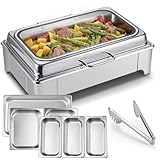

Best electric buffet servers by hosting situation
| Hosting situation | Best format | What to look for | Typical market range |
|---|---|---|---|
| Apartment or dinner for 2–6 | Two-tray buffet server | 1.5–2.5-quart pans, compact footprint, adjustable thermostat | $35–$70 |
| Regular family gatherings for 6–12 | Three-tray warming server | Three 2.5-quart pans, 150–250 watts, removable inserts | $50–$100 |
| Large holiday meals for 12 or more | Full-size chafing-style electric warmer | Three full-size pans or two large pans, separate temperature control | $90–$180 |
| Potlucks and transporting food | Heated food carrier | Insulated case, locking lid, removable power cord, spill resistance | $60–$150 |
| Occasional entertaining on a tight budget | Electric hot plate plus serving dishes | At least two heat settings and stable, wide feet | $25–$60 |
Our top picks, by type
Best overall: a three-tray adjustable buffet server
A conventional three-tray electric buffet server offers the most useful balance for home entertaining. The common arrangement is three removable food pans, each holding about 2.5 quarts, above a shallow water reservoir. A thermostat or low-to-high dial supplies gentle heat through the water bath, helping food stay warm without the aggressive bubbling that can dry out sauces or overcook vegetables.
This format works well for a main dish, a starch, and a vegetable or side. Models sold under brands such as Oster, Elite Gourmet, and NutriChef commonly occupy this category, although exact wattage, pan dimensions, lids, and included utensils vary by model and region. Check the specification sheet before buying rather than assuming that every three-tray unit uses the same insert size.
Choose a unit with stainless-steel food pans, a separate water pan, cool-touch handles, and a removable thermostat or power cord if possible. A clear lid is useful for identifying food, but it tends to collect condensation and can drip onto the serving surface when lifted.
Best for small spaces: a two-tray server
A two-tray model is easier to store and usually consumes less counter space than a three-tray unit. It is a sensible choice when you serve four to six people or already have a large serving bowl for salad and bread. The compromise is flexibility: two 2-quart pans may be insufficient for a holiday meal, and some compact models divide the available heat unevenly between the pans.
Measure the counter area before ordering. A typical two-tray unit may be about 19–23 inches wide and 9–13 inches deep, while a three-tray unit often approaches 24–28 inches wide. Allow several additional inches behind the appliance for the cord and room to lift lids without hitting a wall or backsplash.
Best for large gatherings: a full-size electric chafing-style warmer
For twelve or more guests, look beyond the small divided servers used for family dinners. Full-size electric warmers accept standard hotel pans, often in full-size or half-size formats. A full-size pan can hold considerably more food than three small consumer inserts, but the appliance also needs more table space and may require two outlets if you use multiple units.
These warmers are better for large quantities of pasta, pulled meat, rice, or casserole. They are less convenient for a menu with several small portions because changing pans and washing the larger water basin takes more effort. Independent temperature controls are especially valuable when one pan contains a delicate sauce and another contains dense food that needs more heat.
Best for potlucks: an insulated heated carrier
A heated carrier is the better choice when the food must travel. It normally has an insulated soft or semi-rigid case, a lidded dish, and a power cord for warming at the destination. It is not usually as convenient as an open buffet server for guests to serve themselves, but it reduces the risk of carrying uncovered pans across a car or setting a hot appliance on an unprotected table.
Look for a carrier with a washable liner, a secure lid, a cord compartment, and a dish that can be removed without disturbing the insulation. These are designed to maintain serving warmth, not to rapidly heat a cold meal. Heat the food fully before transferring it.
What matters most when comparing electric buffet servers
Warming capacity
Capacity is more than the number of trays. Three 2.5-quart pans provide 7.5 quarts of nominal space, but you should not fill them to the rim. Leaving roughly 1 inch of headroom reduces splashing and makes lids easier to replace. In practical terms, a three-tray server is suitable for several side dishes or a modest main course, not necessarily 7.5 quarts of one dense food.
Dense foods such as mashed potatoes and casseroles warm more slowly than gravy or steamed vegetables. If you need to bring food from refrigerator temperature to serving temperature, use an oven or stovetop first and use the buffet server for holding.
Temperature control
A continuously adjustable dial is preferable to a simple warm, low, and high switch. The useful operating range is gentle holding heat rather than cooking heat. A control light confirms that the appliance is drawing power, but it does not prove that every corner of the pan has reached the same temperature.
Water-bath designs distribute heat more gently, while dry-heating designs can be quicker to set up but may create hot spots. For rice, sauces, and foods that dry easily, a water reservoir is usually the safer design choice. Follow the manual’s water-level guidance; too little water can cause uneven heating, while too much can splash into the controls when pans are inserted.
Pan sizes and interchangeability
Do not assume that “three tray” means three standard pans. Consumer inserts are often proprietary and may be shallow, narrow, or divided. Confirm the length, width, depth, and capacity of replacement pans before buying. Stainless steel is the most durable choice for frequent use, while aluminum heats quickly but may dent more easily. Nonstick inserts can simplify cleanup, but scratched coatings are a reason to replace the pan rather than continue using it.
Materials and construction
Stainless-steel lids and pans tolerate repeated washing better than thin painted metal. Look for a rigid base, non-skid feet, hinges that do not flex, and handles that remain cool enough to grasp safely. A lightweight plastic body is not automatically poor quality, but thin plastic around the heater may discolor over time if the appliance is repeatedly run dry.
Cord length and placement
A cord around 4 feet long gives more flexibility than a short 2-foot lead, especially when the buffet table is away from the wall. A detachable cord is easier to store and keeps the electrical connection away from the sink during washing. Avoid extension-cord tangles around guests; if an extension is unavoidable, use one rated for the appliance’s wattage and position it where nobody can trip.
A simple capacity calculation
Suppose you are serving eight people and expect each person to eat about 6 ounces of a side dish. The requirement is 48 ounces, or 3 quarts. A 2.5-quart pan would be too small once headroom is allowed. Two pans sharing that side dish, or one 4-quart-plus pan, gives a more comfortable margin.
For a three-tray server, plan the menu around the usable capacity rather than the advertised total. Three nominal 2.5-quart pans may provide approximately 6.5–7 quarts of practical serving space after allowing room for stirring and lids. That is often enough for three different sides for eight to twelve people, but not for three large main-course portions.
Setup and cleanup that protect the appliance
- Preheat the base. Add the recommended amount of hot water, install the empty pans, and preheat for about 10–15 minutes. Starting with hot water reduces the time the food spends warming.
- Heat food separately. Bring chilled food to serving temperature in an oven, microwave, or saucepan. The buffet server is primarily a holding appliance.
- Keep lids on. Replace the lid between servings to slow moisture loss. Stir thick foods occasionally, especially near the edges.
- Empty promptly. Do not leave food sitting indefinitely after the event. Follow safe food-handling guidance for the specific dish and local regulations.
- Cool before washing. Unplug the server, remove pans and water, and let the base cool fully. Wash removable parts with warm soapy water and dry them completely.
- Wipe, never immerse, the base. Water entering the thermostat, heating element, or electrical socket can cause failure. Clean dried spills before the next use because sugars and fats can bake onto the housing.
Ownership realities: what wears out first
The most common failures are not usually the metal pans. Thermostat switches, indicator lights, detachable cord connections, warped plastic lids, and non-skid feet tend to show wear first. A pan that is slightly dented may still function, but a loose electrical connection or a control that cycles erratically is a reason to stop using the appliance.
Replacement pans and lids are worth checking before purchase. A low-cost server becomes less economical if one lost insert requires replacing the entire appliance. For frequent hosts, spending more on stainless-steel pans, a sturdy water reservoir, and available replacement parts can cost less over several years than replacing a lightly built unit every season.
Bottom line
Choose a three-tray, adjustable-temperature water-bath server for the best all-purpose home setup. Select a two-tray model when storage and counter space matter more than menu variety, a full-size chafing-style warmer for large quantities, and an insulated heated carrier when transporting food is the main task. Prioritize usable pan capacity, removable stainless-steel inserts, a cord of roughly 4 feet, and simple cleanup over extra accessories that do not improve heat control.
Related Reviews & Guides

Best Kitchen Islands for More Prep and Storage
Best 2-Slice Toasters for Even, Fast Toasting