Last Updated: September 18, 2026
- Decide These 3 Things First
- Size: Tip Width and Barrel Dimensions
- Material: Ink Formula and Grip Surface
- Construction: Retractable, Capped, or Refillable
- Comfort and Performance: Drying Time, Pressure, and Smear Risk
- Price Tiers: What You Actually Get
- Warranty and Refill Support
- Delivery and Pack Details
- Spec Checklist
- Red Flags
- FAQ
Left-handed writers often shop for a pen by ink color, tip size, or price alone. That is usually where the trouble starts. A left-handed writer’s hand moves across freshly written ink, so a pen that feels excellent to a right-handed user can smear, drag, or leave a heavy trail under a southpaw’s hand. The best choice depends less on a label that says “left-handed” and more on ink chemistry, drying behavior, grip shape, and writing position.
Another common mistake is assuming that every gel pen is slow or that every ballpoint dries instantly. Formulas vary considerably. A fine gel pen may work well for a fast overwriter, while a broad, saturated gel can remain vulnerable to smudging. Likewise, a standard ballpoint may dry quickly but require more pressure, which can cause hand fatigue. Use this left handed pen buying guide ink drying time advice to compare the complete writing experience rather than one marketing claim.
As an Amazon Associate we earn from qualifying purchases at no extra cost to you. Product prices and availability are accurate as of the date shown and are subject to change.



Decide These 3 Things First
- Your writing style: If you write with your hand above the line, choose the fastest-drying ink available and a fine or medium point. If your hand stays below the line, you have more flexibility.
- Your preferred feel: Ballpoints generally offer more control and less ink output. Gel pens glide more easily but can deposit a wetter, darker line.
- Your daily workload: For several pages of notes, prioritize a comfortable grip and a refillable or multi-pack design. For occasional forms, a low-cost retractable pen may be sufficient.
Before buying, test—or confirm—the tip size, ink type, grip diameter, barrel length, and whether replacement refills are available. These details are more useful than a generic “quick-drying” label.
Size: Tip Width and Barrel Dimensions
Tip size is the most practical size specification for a left-handed pen. A 0.5 mm tip usually creates a narrower line with less ink on the page, while a 0.7 mm tip produces a smoother, more prominent line. Fine points from 0.38 to 0.5 mm are often a good starting point for left-handed note-taking because they limit ink volume and allow smaller writing. Medium points from 0.7 to 1.0 mm feel smoother but can take longer to become smear-resistant.
Barrel dimensions affect control and fatigue. Look for a pen approximately 13 to 16 mm in diameter, including the grip, and about 135 to 150 mm long. Very slim barrels under 10 mm can encourage a tight grip. Oversized barrels above 18 mm may feel awkward for small hands, especially during long writing sessions. A typical capped or retractable pen weighs about 8 to 15 grams; metal-bodied models may reach 20 to 30 grams. Extra weight can feel substantial, but it is not automatically more comfortable.
Material: Ink Formula and Grip Surface
Ink type matters more than the exterior material. Oil-based ballpoint ink is usually the safest starting point for fast writers because it lays down a relatively controlled line. Hybrid ballpoint ink is often smoother while retaining much of the quick-drying behavior associated with ballpoints. Gel ink uses water-based pigment or dye and typically feels smoother, but drying time can vary with line width, paper coating, and ink saturation.
For the barrel and grip, plastic keeps the pen light and affordable. Rubber or elastomer grips can reduce slipping, particularly if your hand presses down while pushing the pen across the page. Silicone-like grips may attract dust over time, while hard plastic can become uncomfortable during long sessions. Metal sections add durability and weight but can feel cold or slippery. Choose a textured or rubberized section around 8 to 12 mm long if you commonly write for more than 30 minutes at a time.
Construction: Retractable, Capped, or Refillable
A retractable pen is convenient for school, work, and forms because it can be operated with one hand and does not require a cap. Check that the nose cone does not wobble when the tip is extended. Excess movement can make fine writing feel inconsistent. A capped pen can protect the tip and prevent accidental marks, but the cap should post securely on the back without making the pen unbalanced.
Look for a clip that is firmly attached, a click mechanism that engages fully, and a tip housing with minimal lateral play. For gel pens, a visible ink reservoir is useful because it shows whether the pen is nearing empty. Refillable models cost more initially but can reduce waste and preserve a familiar grip. If you use multiple colors, a three- or four-count pack may be more practical than buying single pens.
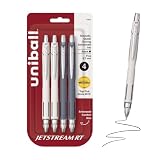
Examples illustrate the range. The Maped Visio left-handed ballpoint set is sold as a three-count pack at about $11.39, while the four-count uniball Jetstream RT 0.7 mm set is listed around $6.47. These are ballpoint-style options for shoppers who favor controlled ink flow. The Pentel EnerGel RTX 0.7 mm retractable gel pen, sold in a two-pack around $3.34, prioritizes glide and a darker line; it may suit a left-handed writer who does not write directly over wet ink.
Comfort and Performance: Drying Time, Pressure, and Smear Risk
Drying time is not a fixed number. It changes with paper weight, coating, humidity, line width, writing speed, and how much pressure you use. A fine line may become smear-resistant sooner than a broad line from the same pen. Glossy planners and inexpensive coated notebook paper can hold ink longer than ordinary copy paper.
When comparing pens, perform a simple home test. Write three lines at your normal speed on the paper you use most. Immediately drag a clean finger across the first line, then repeat after 5, 10, and 30 seconds. Record whether the ink smears, skips, or leaves a visible deposit on your skin. This is not a laboratory rating, but it is more relevant than a general claim about quick drying.
Pay attention to pressure. If a ballpoint requires force to produce a dark line, it may cause finger or wrist fatigue. If a gel pen flows too freely, it may smear beneath your palm. A comfortable pen should write consistently with light to moderate pressure. The grip should also keep your fingers roughly 10 to 15 mm from the tip; gripping too close increases contact with the page and can make your hand drag through wet ink.
Price Tiers: What You Actually Get
Budget pens generally cost about $1 to $3 per pen, or $4 to $12 for a multipack. At this level, expect plastic barrels, basic grips, and limited refill choices. They are practical for classrooms, shared offices, and testing different tip sizes.
Mid-range pens cost roughly $3 to $7 each, or $8 to $20 per pack. This tier commonly offers smoother hybrid or gel formulas, better clips, more consistent retractable mechanisms, and replacement refills. The uniball Jetstream example is priced in the budget-to-midrange area, depending on the seller and pack configuration.
Premium pens start around $8 per pen and can exceed $20, especially with metal bodies or specialized refills. You are mainly paying for materials, balance, finish, and long-term serviceability—not necessarily faster drying. A costly pen can still smear if its ink is broad and wet, so performance should remain the deciding factor.
Warranty and Refill Support
Disposable pens rarely include a meaningful warranty. For a multipack, inspect the return policy and keep the packaging until you confirm that each mechanism works. A faulty clicker, cracked grip, or dried cartridge is a reasonable reason to request a replacement under the seller’s policy.
For a premium body, look for a clearly stated limited warranty and a refill standard that will remain easy to find. Common refill lengths are approximately 98 to 110 mm, but compatibility is not guaranteed by appearance alone. Confirm the manufacturer’s refill code or dimensions before buying several replacements. A pen body that accepts refills priced at $1 to $3 each is usually easier to maintain than one requiring a proprietary cartridge.
Delivery and Pack Details
Delivery is not an assembly issue for pens, but pack details can affect the real value. Confirm whether the advertised price is for one pen, two pens, or a three- or four-count pack. Check that the listing specifies black ink if that is your requirement; product names sometimes combine several colors under one listing.
Inspect the stated tip size, since a 0.7 mm pen may be described as medium even when the resulting line varies by ink formula. If buying online, choose packaging that protects retractable tips and confirm the return window. Pens do not require assembly, but a multi-part grip or refill system should arrive fully seated and ready to test.
Spec Checklist
| Spec | Budget | Mid | Premium |
|---|---|---|---|
| Typical price | $1–$3 per pen; $4–$12 per pack | $3–$7 per pen; $8–$20 per pack | $8–$25+ per pen |
| Tip size | 0.5–0.7 mm | 0.38–0.7 mm | 0.38–1.0 mm options |
| Ink type | Basic oil ballpoint or gel | Hybrid ballpoint or smoother gel | Specialized or premium refill formula |
| Weight | 8–12 g | 9–18 g | 15–30 g |
| Barrel diameter | 10–14 mm | 12–16 mm | 13–18 mm |
| Best use | School, forms, testing styles | Daily notes and office work | Long-term use and refillability |
Red Flags
- “Instant-dry” without an ink type: Treat the claim as incomplete unless the listing identifies the formula and tip size.
- No tip measurement: “Fine” and “medium” are not universal standards. Look for a measurement in millimeters.
- Wet, oversized tips: Tips from 0.8 to 1.0 mm may create attractive lines but increase smear risk for overwriters.
- Unclear pack quantity: Verify whether the price covers one pen or multiple pens.
- Loose nose cone or clicker: Mechanical play can make a pen feel scratchy even when the ink is smooth.
- Unspecified refill compatibility: A premium barrel is less useful if replacement ink is difficult to obtain.
- Overly slick grips: Smooth metal or glossy plastic can force a tighter grip and increase fatigue.
FAQ
What is the fastest-drying pen type for left-handed writers?
Oil-based and hybrid ballpoints are usually the safest choices for fast writing, especially in 0.5 to 0.7 mm tips. Actual drying performance depends on paper and writing pressure, so test the pen on your everyday notebook or printer paper before committing to a large pack.
Are gel pens a bad choice for left-handed writers?
No. Gel pens can be excellent when you want a smooth, dark line and use absorbent paper. Choose a fine tip, write with light pressure, and test for smearing at your normal speed. A 0.7 mm gel pen may work well for an overwriter on ordinary paper but remain wet longer on glossy stock.
Is a left-handed pen different from a regular pen?
Some are shaped with a grip or tip orientation intended to support a left-handed angle, but the label alone does not guarantee faster drying. Ink formula, tip width, grip comfort, and writing position are more important. Compare those specifications with ordinary ballpoint and hybrid pens.
How can I reduce smearing without changing pens?
Use less pressure, choose more absorbent paper, and allow a short pause before placing your palm over a fresh line. Narrowing the tip from 0.7 mm to 0.5 mm can also reduce ink deposited on the page. If smearing continues, switch from a wet gel to a hybrid or oil-based ballpoint.
Ready to decide? Our #1 pick for 2026 is the Typical price.
Live price & availability on Amazon.
Related Reviews & Guides


Quick Picks: Best Left-Handed Vegetable Spiralizers

How to Configure Left Handed Mouse Buttons (2026): Step-by-Step