Last Updated: September 18, 2026
Quick answer: Our top pick in 2026 is the Top-bound steno pad — our #1 rated choice. See the full ranked comparison, alternatives and buying advice below.
The Short Answer
Maybe—but only if a standard notebook’s left-side spiral, binding, or page layout regularly gets in the way of your writing. A left-handed notebook is most useful for people who write with their left hand and find themselves resting their hand on metal rings, pushing against a thick spine, or smearing freshly written ink. If those problems sound familiar, a left-handed notebook can make everyday note-taking noticeably more comfortable. If you already write comfortably in ordinary composition books or top-bound pads, you probably do not need one.
The key difference is simple: a left-handed spiral notebook places the spiral binding on the right side when the notebook is open for writing. That leaves a smooth edge under your hand and lets the pages turn away from your writing arm.
As an Amazon Associate we earn from qualifying purchases at no extra cost to you. Product prices and availability are accurate as of the date shown and are subject to change.

What You Actually Get
A left-handed notebook is not usually a different kind of paper. It is primarily a different binding and page orientation. Most models use familiar college-ruled paper, a standard cover, and a conventional size, but they are assembled for left-handed use.
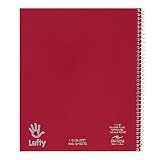
For example, the ROARING SPRING Left Handed Notebook is an 11-by-9-inch, one-subject notebook with college-ruled pages. It comes in a three-pack priced at about $23.87, or roughly $7.96 per notebook. The larger-than-letter proportions give you useful writing space without moving up to a bulky legal-size pad.
The ROARING SPRING Lefty Spiral Notebook has the same general 11-by-9-inch format, 100 sheets, college ruling, perforated pages, and assorted Saranac covers. It is listed at about $8.49 for one notebook. Perforation is helpful if you hand in assignments or regularly move notes into a folder, although tearing out pages will reduce the notebook’s remaining capacity.
Expect the usual features of a school or office notebook: blue horizontal ruling, a cover that provides some structure, and enough pages for a class unit, project, journal, or meeting notes. The left-handed design does not automatically mean the paper is thicker, the cover is more durable, or the ink will dry faster. Check those specifications separately if they matter to you.
Pros
- More comfortable wrist placement. With the spiral on the right, your writing hand rests on the flat edge of the page rather than on a row of metal or plastic coils.
- Less interference as you write. Left-handed writers often move across the page toward the binding. A left-side spiral can force the hand into the rings, while a right-side spiral keeps that obstruction away.
- Fewer smudges for some writers. A left-handed person commonly moves the hand over words that were written moments earlier. The notebook cannot solve ink-drying problems, but a more natural page angle may help you keep your hand from dragging across the line.
- Full use of a double-page spread. When the notebook is open, the writing area is arranged for a left-handed user instead of making the binding the center obstacle.
- Familiar school-friendly format. An 11-by-9-inch notebook is large enough for class notes while remaining easy to carry in many backpacks and tote bags.
- Useful page removal. The ROARING SPRING Lefty model includes perforated sheets, which can be convenient for submitting homework or organizing loose notes.
- Reasonable per-notebook pricing. A multipack can bring the price below $8 per notebook, while a single notebook around $8.49 lets you test the format without committing to several.
Cons
- It may cost more than a basic notebook. Standard spiral notebooks are widely sold for a few dollars, especially during back-to-school sales. A specialty orientation can add to the price.
- Availability is narrower. Most stores stock right-handed spiral notebooks, composition books, and legal pads. Left-handed versions may require ordering ahead or buying multipacks.
- The adjustment can feel strange. If you are used to flipping pages from right to left, a notebook that opens in the opposite direction may initially feel backward. The cover can also fold differently when you write near the beginning or end.
- It does not fix every left-handed writing issue. Smearing depends heavily on the pen, ink, paper coating, writing speed, and your hand position. A left-handed notebook is not a substitute for quick-drying ink.
- Sharing can be less convenient. A teacher, coworker, or family member who writes right-handed may find the layout unfamiliar. This matters if the notebook is a shared reference book.
- Paper and covers vary. “Left-handed” describes the binding orientation, not a guaranteed paper weight or cover quality. A model may still feel thin or bend in a packed bag.
Who Should Buy It
Buy a left-handed notebook if you write left-handed every day and regularly notice the spiral binding beneath your palm. It is especially worth trying if you take several pages of notes at a time, write from left to right across wide pages, or use pens that smear when your hand passes over fresh ink.
Students can benefit because college-ruled pages provide more lines for lecture notes, while perforated sheets make it easier to submit individual assignments. Office workers, journalers, and anyone who fills notebooks from front to back may also appreciate the reduced pressure on the wrist. The best test is practical: place your hand on the binding of a normal spiral notebook and write several lines. If the coil immediately feels annoying, the specialty version addresses a real problem rather than adding a gimmick.
If you are trying one for the first time, the single ROARING SPRING Lefty Spiral Notebook at about $8.49 is the lower-commitment choice. If you already know you like the orientation, the three-pack at about $23.87 lowers the approximate unit price and gives you backups.
Who Should Skip It
Skip it if you normally use composition books, top-bound notebooks, or inexpensive standard spirals without discomfort. A right-handed notebook is also unnecessary if you mostly write on loose paper, use a tablet, or take only brief notes.
You may also want to skip a left-handed spiral if you frequently pass the notebook around or need every member of a team to use the same format. A top-bound reporter’s notebook can provide many of the same advantages without committing to a reversed side spiral. And if ink smearing is your only complaint, changing pens may solve the problem more cheaply than changing notebooks.
Cheaper Alternatives
| Option | Cost | Trade-off |
|---|---|---|
| Top-bound steno pad | About $2–$6 | No side spiral under your hand, but the writing area is often narrower and the pad may not lie as flat. |
| Standard composition book | About $2–$5 | Usually comfortable for left-handed writers because there is no spiral, but pages are not perforated and the cover may be less flexible. |
| Standard spiral notebook | About $2–$8 | Lowest-cost option, but the binding remains on the left and can press into your hand. |
| Loose-leaf paper in a binder | About $5–$15 to start | Pages can be rearranged and removed, but left-side binder rings create the same hand-contact issue. |
| Quick-drying pen plus a regular notebook | About $3–$12 | May reduce smearing, but it does not change the spiral’s position or improve wrist clearance. |
FAQ
What makes a notebook left-handed?
Usually, the spiral binding is placed on the right side when the notebook is positioned for writing. Some products may also reverse the cover printing or page direction, but the binding orientation is the feature that matters most. Confirm product photos before buying because terminology can vary.
Are left-handed notebooks better for preventing ink smears?
They can help indirectly by giving your hand a more natural path across the page, but they do not guarantee smear-free writing. A fast-drying gel pen, ballpoint, or hybrid ink may make a larger difference. Paper type and your writing posture also matter.
Is an 11-by-9-inch notebook too large to carry?
It is larger than a typical 8.5-by-11-inch sheet in one direction but still close to a common school-notebook size. It should fit many backpacks and work totes, though you should measure your bag’s interior if the fit is tight. A 100-sheet notebook will also take more space than a slim memo pad.
Should I buy one notebook or a three-pack?
Buy one if you are unsure whether the reversed spiral will feel natural. Choose the three-pack if you already know standard notebooks bother your hand or if you need separate books for multiple classes or projects. At the listed prices, the three-pack costs about $7.96 per notebook, compared with about $8.49 for the single option, so the savings are modest but real.
For 2026, the honest verdict is still straightforward: you do not need a left-handed notebook simply because you are left-handed. You need one if the binding of a standard notebook causes discomfort or gets in the way. If it does, the small premium is a practical upgrade; if it does not, a composition book or ordinary pad will likely serve you just as well.
Ready to decide? Our #1 pick for 2026 is the Top-bound steno pad.
Live price & availability on Amazon.
Related Reviews & Guides


8 Best Left Handed Acoustic Guitars: Reviews & Guide

Is an Electric Can Opener Worth It? An Honest Answer (2026)