Last Updated: September 18, 2026
- Top Pick: Fiskars 8" Left-Handed All-Purpose Scissors for Fabric & Crafts, Red
- Best Value: Fiskars 8" Left-Handed Titanium All Purpose Scissors for Office
- Premium Choice: Tim Holtz Left Handed Scissors – 5 Inch Mini Snips with Micro Serrated Blade – Lefty Craft Tool for Cutting Paper, Fabric, and Sewing – Titanium with Black Comfort Grip Handles
Choosing scissors for smaller hands is about more than overall length. A long blade may cut efficiently, but an oversized handle can force your fingers to stretch, twist your wrist, or squeeze harder than necessary. For shoppers comparing left handed scissors dimensions for small hands, the most useful measurements are total length, blade length, handle opening, finger-loop height, and weight.
Left-handed scissors should have blades arranged for a left-handed user, so the cutting line remains visible and the blades meet correctly when pressure comes from the left hand. The examples commonly sold today range from compact 5-inch craft snips to general-purpose 8-inch models. In this guide, measurements are given in both inches and centimeters, with practical fit advice for smaller adult hands, teens, and older children.
As an Amazon Associate we earn from qualifying purchases at no extra cost to you. Product prices and availability are accurate as of the date shown and are subject to change.


The Short Answer
For most small hands, the best starting point is a pair measuring 5 to 7 inches (12.7 to 17.8 cm) overall, with a handle opening of about 2.25 to 3 inches (5.7 to 7.6 cm). Choose 5-inch scissors for detail work, sewing, paper crafts, and short cutting sessions. Choose 7- or 8-inch scissors when you need longer cuts through fabric, cardboard, or several sheets of paper.
Look for a finger loop that lets the thumb and fingers enter without rubbing the sides. The hand should not need to stretch across the entire opening. A soft grip can improve comfort, but it does not compensate for a loop that is too large. For small hands, a lighter pair—roughly 1.5 to 3.5 ounces (43 to 99 grams)—is usually easier to control than a heavy professional shear.
Standard Sizes
Scissor sizing usually refers to the complete tool from the tip of the blade to the back of the handle. It does not consistently describe blade length or handle-opening size, so compare all three measurements when possible.
| Scissor type | Overall length | Blade length | Typical handle opening | Best use |
|---|---|---|---|---|
| Embroidery or detail snips | 3.5–4.5 in (8.9–11.4 cm) | 1.25–2 in (3.2–5.1 cm) | 1.75–2.25 in (4.4–5.7 cm) | Thread, embroidery, trimming |
| Mini craft scissors | 5 in (12.7 cm) | 2–2.5 in (5.1–6.4 cm) | 2.25–2.75 in (5.7–7 cm) | Paper, sewing, detail cutting |
| Compact all-purpose scissors | 6–7 in (15.2–17.8 cm) | 2.75–3.5 in (7–8.9 cm) | 2.5–3 in (6.4–7.6 cm) | General household and craft work |
| Full-size all-purpose scissors | 8 in (20.3 cm) | 3.5–4 in (8.9–10.2 cm) | 2.75–3.5 in (7–8.9 cm) | Fabric, office, cardboard, packaging |
| Dressmaking or tailor shears | 9–10 in (22.9–25.4 cm) | 4–5 in (10.2–12.7 cm) | 3–4 in (7.6–10.2 cm) | Long, straight fabric cuts |
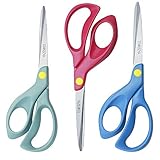
The 5-inch Tim Holtz left-handed mini snips are a useful reference point for small-hand shoppers. They are compact enough for controlled cutting and typically cost about $10 to $15. An 8-inch Fiskars left-handed all-purpose or titanium pair is longer and more versatile, with example prices around $9 to $11. An 8-inch stainless-steel three-pack may cost approximately $8 to $12, but a lower price can mean simpler handles or less consistent finishing. Prices vary by retailer, color, and package contents.
At 8 inches, the blade gives you better efficiency on fabric and large sheets, but the handle may feel oversized if your palm is narrow or your fingers are short. A titanium coating can improve resistance to surface wear, but it does not change the fundamental handle dimensions.
How to Measure Your Space
Before buying, measure the hand that will actually use the scissors. The goal is to match the finger loops to your grip, not simply to select the shortest pair.
- Measure hand length. Place your palm flat with fingers together. Measure from the wrist crease to the tip of the middle finger. A hand under about 6.75 inches (17.1 cm) often feels more comfortable with 5- to 7-inch scissors, although finger length and grip preference matter.
- Measure palm width. Measure straight across the palm below the knuckles, excluding the thumb. A palm narrower than about 3.25 inches (8.3 cm) may feel crowded in wide, rigid handles.
- Measure the working finger span. Open your thumb and middle finger naturally, without forcing them apart. The handle opening should be shorter than your maximum span so you can close the blades without fully extending your hand.
- Check the thumb loop. Your thumb should enter the smaller loop comfortably and still have room to move. You should not need to push past the first thumb joint or press against a sharp plastic edge.
- Check the finger loop. For small hands, a finger opening around 2.25 to 2.75 inches (5.7 to 7 cm) is a useful starting range. If the opening is much larger, look for cushioned inserts or a compact model.
- Measure your cutting surface. For a small desk or craft mat, a 5- to 7-inch pair is easier to turn and store. An 8-inch pair needs more clearance, particularly when cutting fabric that extends beyond the table.
- Confirm left-handed construction. Do not rely only on a colored handle or the phrase “ambidextrous.” A true left-handed pair should position the upper blade and cutting action for visibility from the left side.
By Room or Use Case
Craft room
A 5-inch pair is a strong choice for scrapbooking, paper piecing, vinyl, ribbon, and small fabric pieces. The shorter blade gives better control around curves and corners. Choose a smooth, cushioned handle if you cut for more than 15 or 20 minutes at a time.
Sewing room
For thread and seam trimming, use 3.5- to 5-inch snips. For cutting pattern pieces or fabric yardage, 7- to 8-inch fabric scissors are more efficient. A small-handed sewer may prefer an 8-inch blade paired with a narrow, ergonomic handle rather than moving up to 9- or 10-inch shears.
Home office
Compact 6- to 8-inch left-handed scissors handle paper, envelopes, tape, and thin packaging. If the scissors will sit in a drawer, check the closed length and handle width; an 8-inch pair generally needs at least 8.5 inches (21.6 cm) of diagonal drawer space to remove it easily.
Kitchen and utility drawer
Choose a dedicated household pair rather than using delicate craft snips on cardboard or plastic. A 7- or 8-inch model gives better leverage, while a lighter design reduces hand fatigue. Keep utility scissors separate from food-preparation shears unless the product is specifically designed for kitchen use.
Children and older adults
Children generally need 3.5- to 5-inch scissors with rounded tips and appropriately sized loops. For older adults or anyone with reduced grip strength, prioritize a light 5- to 7-inch pair, wide soft handles, and a low-resistance pivot. Avoid assuming that a larger handle is easier; excessive opening size can make every cut more demanding.
Common Sizing Mistakes
- Choosing by overall length alone: Two 8-inch scissors can have noticeably different loops and blade-to-handle proportions.
- Buying the largest pair for leverage: Longer scissors can cut more with each stroke, but they may be tiring and difficult to steer with small hands.
- Ignoring closed thickness: Bulky comfort handles may not fit well in a narrow drawer, sewing box, or desk organizer.
- Confusing ambidextrous with left-handed: A symmetrical handle does not always provide the correct blade overlap for left-handed cutting.
- Using oversized loops without testing the grip: If your fingers slide forward, control decreases and the scissors may pinch the web between thumb and finger.
- Comparing price instead of construction: A $8 to $13 pair can be perfectly suitable for paper and light crafts, while frequent fabric use may justify stronger blades and a more comfortable pivot.
FAQ
What is the best scissor length for small hands?
Most small-handed adults do well with 5- to 7-inch scissors. Choose 5 inches for precision and 7 inches for more general-purpose cutting. An 8-inch pair can still work if its finger loops are compact and comfortable.
Are 8-inch left-handed scissors too large?
Not necessarily. Eight-inch scissors are useful for fabric, cardboard, and long paper cuts. They may feel too large when the handle opening exceeds about 3.25 inches (8.3 cm) or when the user must fully stretch the fingers to close the blades.
How should left-handed scissors fit?
Your thumb should move freely in the thumb loop, while the remaining fingers should rest inside the larger loop without sliding. You should be able to close the blades with a relaxed hand and keep the cutting line visible from the left side.
Are mini scissors strong enough for fabric?
Five-inch mini scissors are suitable for thread, lightweight fabric, felt, patches, and detail work. For denim, canvas, multiple fabric layers, or long seams, choose 7- or 8-inch fabric scissors with longer blades and a sturdy pivot.
Ready to decide? Our #1 pick for 2026 is the Embroidery or detail snips.
Live price & availability on Amazon.
Related Reviews & Guides


3 Best Left Handed Watches: Crowns on the Left Side

Best Labor Day Lawn Mower Sales in 2026: How the Top Models Compare