Last Updated: October 8, 2026
- Best Floor Lamps for Living Room: Bright Ideas
- Quick picks by living-room situation
- How tall should a living-room floor lamp be?
- Shade size matters more than many buyers expect
- Brightness: choose lumens, not just watts
- Best floor-lamp styles, compared head-to-head
- Left-handed details worth checking
- Installation and placement in five steps
- Ownership realities: what wears out first?
- Final buying rule
- Top Pick: Dimmable Floor Lamp, 3 x 800LM LED Edison Bulbs Included, Farmhouse Industrial Floor Lamp Standing Tree Lamp with Elegant Teardrop Cage Tall Lamps for Living Room Bedroom Office Dining Room-Black
- Best Value: Nintiue 【Upgraded】 Dimmable Floor Lamp, 1000 Lumens LED Bulb Included, Arc Floor Lamps for Living Room Modern Standing Lamp with Linen Shade, Tall Lamp for Bedroom Office Reading Dining Room- Black
- Premium Choice: 【Upgraded】 Dimmable Floor Lamp for Living Room,1000 Lumens Bulb Included, Modern Floor Lamps Simple Design with Linen Shade, Tall Standing Lamp for Bedroom Office Dining Room, Black Pole Lamp
Best Floor Lamps for Living Room: Bright Ideas
The best floor lamp for a living room is one that puts its light source beside—not behind—your seating, rises high enough to spread light without shining into your eyes, and provides roughly 800–1,600 lumens for a typical layered lighting plan.
Rather than choosing by appearance alone, match the lamp’s height, shade diameter, and brightness to the room and the way you use it. A compact arc lamp can solve a dark reading corner, while a slim uplighter can make a small room feel taller without taking up valuable floor space.
As an Amazon Associate we earn from qualifying purchases at no extra cost to you.


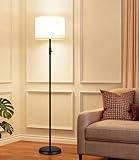

Quick picks by living-room situation
| Living-room need | Best lamp type | Recommended specifications | Why it fits |
|---|---|---|---|
| Small room or narrow walkway | Slim torchiere or tripod lamp | 55–65 in tall; base under 11 in wide; 800–1,200 lumens | Uses little floor space and avoids obstructing circulation |
| Sofa reading corner | Adjustable task lamp or compact arc lamp | 50–68 in tall; 800–1,200 lumens; 2700–3500K | Directs useful light toward a book without lighting the whole room harshly |
| Large sectional | Long-arc lamp or multi-light floor lamp | 60–75 in tall; 1,200–2,000 lumens; 16–24 in shade span | Reaches over deep seating and covers a wider area |
| Low-ceiling apartment | Drum-shade floor lamp | 58–66 in tall; shade 12–18 in wide; dimmable LED | Provides ambient light while keeping proportions comfortable |
| Decorative background lighting | Globe or sculptural lamp | 45–60 in tall; 400–800 lumens; frosted diffuser | Adds softness and visual interest without competing with task lighting |
How tall should a living-room floor lamp be?
For most sofas and lounge chairs, a floor lamp between 58 and 68 inches tall is the safest starting point. When you are seated, the bottom of the shade should usually sit around eye level or slightly above it. This conceals the bare bulb and reduces glare.
Place the lamp beside the arm of the sofa rather than directly behind your head. If the shade is visible in your peripheral vision while reading or watching television, raise the lamp, use a more opaque shade, or move it farther to the side.
Height also depends on the ceiling. In a room with an 8-foot ceiling, a 60–66-inch lamp leaves enough visual breathing room. A 72-inch lamp may work in a taller room, but can look top-heavy beside a low sofa. For a low-profile sectional, choose a lamp whose shade is approximately 8–16 inches above the back of the seat.
Shade size matters more than many buyers expect
A shade that is too narrow produces a concentrated pool of light and can make a substantial sofa look oversized. A shade that is too broad may intrude into a walkway or overwhelm a small side table.
- For a compact chair or loveseat, choose a shade about 12–16 inches wide.
- For a standard sofa, 14–20 inches is usually better proportioned.
- For a deep sectional or open-plan room, consider a 18–24-inch shade or an arc lamp with a wider reach.
- Keep at least 18–24 inches of clear walking space around the lamp base where possible.
Drum shades spread light both upward and downward, making them useful for general illumination. Conical shades focus more light downward, which suits reading. Fabric shades soften the beam, while glass and exposed bulbs can create sharper glare unless paired with a frosted bulb or diffuser.
Brightness: choose lumens, not just watts
Watts measure energy consumption; lumens indicate visible light. For a living room, a floor lamp commonly works best as one layer in a larger plan rather than as the only light source.
- 400–800 lumens: gentle accent or background lighting.
- 800–1,200 lumens: comfortable reading and chair-side lighting.
- 1,200–2,000 lumens: broader illumination for a large room or sectional.
A practical target is around 10–20 lumens per square foot for general living-room illumination, depending on wall color, ceiling height, window light, and personal preference. A 180-square-foot room therefore needs approximately 1,800–3,600 lumens in total. That does not mean one floor lamp must provide all of them: a ceiling fixture, table lamp, wall light, and floor lamp can share the job.
For example, combine a 1,000-lumen floor lamp with a 1,200-lumen ceiling fixture and two 400-lumen accent lamps. The total is 3,000 lumens, or about 16.7 lumens per square foot in a 180-square-foot room. Dimmers make this arrangement useful in both daytime and evening.
Best floor-lamp styles, compared head-to-head
Arc lamp versus adjustable task lamp
An arc lamp is better when the light needs to reach over a sofa or coffee table. Its extended arm can illuminate a seating area without placing a base beside every chair. The trade-off is a larger footprint and a greater risk of tipping if the base is lightweight or the arm is extended too far.
An adjustable task lamp is better for one reader or hobbyist. Its articulated arm and directional shade waste less light, but it will not illuminate a whole seating group as evenly. Look for a weighted base, a stable hinge, and a head that can tilt without drifting.
Torchiere versus shaded lamp
A torchiere sends light toward the ceiling and is useful for lifting shadows in a dark room. It takes little space and works well behind a sofa, but it is a poor primary reading lamp because the light is indirect.
A shaded lamp sends more light downward and outward. It is the more versatile choice beside a reading chair, especially with a dimmable LED bulb. The shade and bulb also conceal the source better than many open torchieres.
Tripod versus round-base lamp
Tripod lamps can look lighter and more decorative, but their legs extend farther into the room. A round or square weighted base is usually safer near a walkway and easier to place beside a sofa. Measure the widest part of the base—not merely the central column—before buying.
Left-handed details worth checking
For a left-handed reader, switch position and cord routing can make an everyday difference. A foot switch mounted on the cord is convenient if it can be approached from either side; a switch fixed on the right side of a narrow pole may be awkward when the lamp is placed to your left.
- Choose a rotary or touch control that can be reached from the seated position.
- Check whether the cord exits from the base toward your preferred wall outlet.
- Prefer lamps with a stable base that does not require reaching across a table to operate.
- For a shared room, select a dimmable lamp rather than one with a single fixed intensity.
If the switch is permanently positioned on one side, place the lamp on the side that keeps the control visible and the cable away from your feet. Cable clips or a low-profile cord cover can reduce trip hazards without forcing the lamp into an inconvenient location.
Installation and placement in five steps
- Map the seating. Sit in the main chair and identify where your shoulder, book, and sightline fall.
- Measure the clear space. Mark the maximum base width that leaves at least 18 inches for comfortable passage.
- Set the shade height. Aim for the shade’s lower edge to be at or just above seated eye level.
- Test the beam. The light should land on the book or floor without shining directly into your eyes or television screen.
- Layer the controls. Use the floor lamp for local light and a separate ceiling or wall source for general illumination.
Do not hide an arc lamp’s base under a rug edge, and do not place a tall lamp where a door, curtain, or reclining chair can strike it. If the lamp wobbles after assembly, tighten the joints and verify that the base is sitting flat before adding a heavier bulb.
Ownership realities: what wears out first?
LED bulbs typically reduce replacement frequency, but integrated LED lamps can be harder to repair if their driver or light board fails. A lamp with a standard replaceable bulb may be the better long-term choice even if its initial price is slightly higher. General market pricing is approximately $30–$80 for basic lamps, $80–$200 for well-built adjustable or arc designs, and $200 or more for substantial designer pieces.
Dust accumulates fastest on upward-facing torchiere bowls and fabric shades. Unplug the lamp, remove the bulb if necessary, and use a soft brush or vacuum upholstery attachment. Never spray cleaner onto a socket, switch, or electrical connection. For metal finishes, follow the maker’s cleaning instructions; abrasive cloths can dull plated surfaces.
Common mistakes include choosing a lamp that is bright but not dimmable, placing a narrow base in a busy walkway, and using a cool 5000K bulb in a room intended to feel relaxed. For most living rooms, 2700–3000K creates warm light, while 3500–4000K can suit a brighter reading or work corner.
Final buying rule
Measure the room and the seating first, then select the lamp: approximately 58–68 inches tall for typical sofas, a shade 12–24 inches wide according to the room’s scale, and 800–2,000 lumens depending on whether it serves one reader or an entire seating area. Add dimming, a stable base, accessible controls, and a replaceable bulb where possible, and the lamp will support layered lighting instead of merely occupying an empty corner.
Related Reviews & Guides




Are Left-Handers More Creative? What Science Says

Best Laptops for Architects: Power and Display