Last Updated: October 8, 2026
The best power recliners for comfort and support are the ones that fit your seated dimensions, leave enough room to recline, offer quiet independent motors, and place controls where a left-handed user can reach them without twisting.
As an Amazon Associate we earn from qualifying purchases at no extra cost to you.


Quick picks by situation
| Situation | Best choice | Specifications to prioritize | Likely market range |
|---|---|---|---|
| Small room or apartment | Wall-hugger power recliner | 32–36 in width, 4–8 in wall clearance, 300–350 lb capacity | $700–$1,500 |
| Daily reading or television use | Dual-motor recliner with power headrest | Independent back and footrest, adjustable head support, 8–12 second full cycle | $1,000–$2,500 |
| Difficulty standing from a low seat | Power lift recliner | Lift function, 19–21 in seat height, 350–500 lb capacity | $800–$2,000 |
| Maximum back and leg adjustment | Three-motor recliner | Independent back, footrest, and headrest or lumbar adjustment | $1,500–$3,500 |
| Children, pets, or frequent spills | Performance fabric upholstery | Tightly woven polyester or treated fabric, removable or replaceable cushions where available | $900–$2,500 |
What separates the best power recliners?
Power recliners vary more in fit and mechanism than their similar-looking photographs suggest. A chair can have a long feature list yet feel uncomfortable if the seat is too deep, the lumbar pad lands below your lower back, or the footrest stops short of your calves.
Reclined dimensions matter as much as the footprint
Measure the chair in both upright and fully reclined positions. A conventional recliner may project 65–75 inches from the wall when open. A wall-hugger can reduce the required wall clearance to roughly 4–8 inches, but it still needs enough forward space for the footrest and your legs. Allow at least 24 inches of clear walking space beside the chair, and avoid placing a side table where it could obstruct the lift mechanism.
For fit, compare the internal seat dimensions rather than the outside width. A useful starting point is:
- Seat height: about 18–21 inches for many adults; taller users may prefer 20–22 inches.
- Seat depth: roughly 20–22 inches for an average build, with a shallower seat often better for shorter users.
- Seat width: about 20–24 inches for a standard chair; wider models may reach 25–30 inches.
- Back height: high-back designs are preferable when you want the headrest to support your head without craning your neck.
When seated upright, your lower back should meet the lumbar area, your knees should bend naturally, and your feet should rest on the floor. If the seat is too deep, place a firm cushion behind your back only if it does not push your shoulders forward or interfere with the recline path.
Single motor, dual motor, or lift-assist?
A single-motor chair generally raises the footrest and reclines the back together. It costs less and has fewer moving parts, but it gives you less control over reading, working, or resting positions.
A dual-motor model moves the back and footrest independently. This is the best balance for most regular users because you can keep your back fairly upright while raising your legs, or recline your back without forcing the footrest fully open. A three-motor design may add powered headrest and lumbar adjustment. Those features are useful when the standard headrest position does not match your body, but each additional actuator adds cost and another component that may eventually need service.
Power lift is different from ordinary reclining. A lift-assist recliner tilts the seat and back upward to help you transition toward standing. It should not be treated as a substitute for professional mobility advice. Check the manufacturer’s weight rating, keep the area in front of the chair clear, and ask a healthcare professional or occupational therapist about safe transfers if standing is difficult or unstable.
Head-to-head comparison of key specifications
| Feature | Basic single-motor | Dual-motor wall-hugger | Power lift recliner | Premium multi-motor |
|---|---|---|---|---|
| Typical outside width | 31–38 in | 32–40 in | 32–40 in | 34–42 in |
| Clearance behind chair | 8–14 in | 4–8 in | 6–12 in | 6–12 in |
| Typical weight capacity | 250–350 lb | 300–400 lb | 300–500 lb | 300–400 lb |
| Independent adjustments | Usually no | Back and footrest | Back, footrest, and lift | Back, footrest, headrest, and sometimes lumbar |
| Typical motor sound | About 50–60 dB | About 45–55 dB | About 50–60 dB | About 45–55 dB |
| Full open or lift cycle | 10–18 seconds | 8–15 seconds | 15–25 seconds | 8–15 seconds |
These are useful comparison ranges, not guarantees for every model. Motor noise depends on the actuator, floor surface, upholstery, and room acoustics. A quiet motor should sound like a smooth electric whir rather than clicking, grinding, or repeatedly stopping under normal load.
Controls and left-handed usability
For a left-handed buyer, the most important question is not whether the chair is labeled “left-handed.” Most power recliners are not handed, but the control layout can make one much easier to use than another.
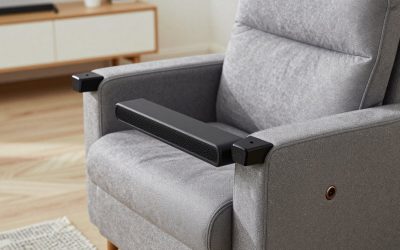
- Choose a handset that can be mounted on either arm, or select a chair with controls on both sides.
- Prefer large, raised buttons that can be identified by touch rather than a flat touch panel.
- Check whether the USB port and cup holder are on the side you actually use.
- Look for a corded remote if you do not want to search for a misplaced wireless handset.
- Confirm that the emergency or manual-return procedure is documented if the remote fails.
Some chairs include memory buttons, heat, vibration, USB charging, or reading lights. These can be convenient, but they should not outweigh poor seat fit or weak lumbar positioning. A remote with too many small, similar buttons can also be frustrating at night.
Upholstery, lumbar support, and long-term comfort
Top-grain leather is durable and easy to wipe, but it can feel cool initially, may show scratches, and usually costs more. Bonded leather can look similar when new but may peel sooner, particularly on high-contact areas. Tightly woven polyester and performance fabrics are often better choices for pets, children, or frequent use. Avoid assuming that “performance” means stain-proof: follow the cleaning code and test products on an inconspicuous area.
Look for lumbar support that remains aligned when the chair reclines. Fixed padding can be perfectly comfortable if it matches your body, while powered lumbar adjustment is more adaptable but adds complexity. If the chair produces a gap behind your lower back in the position you use most, a more expensive upholstery package will not solve the underlying fit problem.
Outlet requirements and placement
Most powered recliners use a low-voltage adapter supplied with the chair, which plugs into a standard household outlet. They commonly draw modest power while moving and very little when idle, but the exact adapter rating varies. Do not substitute a random power supply. Keep the transformer off the floor where it could be crushed, and route the cable away from the lift and footrest mechanisms.
Plan for one accessible outlet per chair. Avoid extension cords and power strips unless the manufacturer specifically permits them and the cord is rated appropriately. A battery backup can be useful in a power outage, especially for a lift recliner, but confirm compatibility and runtime before buying one. A backup is not a reason to ignore the chair’s manual emergency-lowering instructions.
Ownership realities: what wears first
The upholstery on the seat front, arm tops, and footrest is usually exposed to the most abra
Related Reviews & Guides



Are Left-Handers More Creative? What Science Says

Is Left-Handedness Genetic? The Science Explained