Last Updated: October 8, 2026
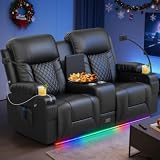
- Top Pick: DG PEAFOWL Recliner Sofa, Home Theater Seating with Center Console, 4 Seat Reclining Couch with USB Ports & Phone Holders, Wall Hugger RV Sofa Furniture Loveseat Recliner Couch with Storage & Pocket
- Best Value: ANJ Home Theater Seating Power Recliner Set of 6 with Arm Storage, Faux Leather Recliner Sofa with LED Light, Electric Movie Reclining Chairs with USB Ports & Cup Holders for Media Living Room, Black
- Premium Choice: ANJ Power Recliner Chair Set of 6, Electric Soft Faux Leather Reclining Home Theater Seating – USB Ports, Cup Holders, Hidden Arm Storage Movie & Media Room Chairs (Black)
Best Home Theater Seating for Comfort and Space
The best home theater seating for most rooms is a compact two-seat row of wall-hugger recliners; choose a straight three-seat row for a wide room, a sectional for flexible lounging, or fixed theater seats when preserving floor space matters more than reclining. The key is to compare each seat’s open depth—not just its footprint when upright—and leave a usable aisle.
Compare configurations before choosing
Dimensions vary by model, so treat the ranges below as planning estimates, not guaranteed specifications. Measure the exact chair and its fully reclined position before buying. “Open depth” means the distance from the back of the chair to the front edge when reclined.
As an Amazon Associate we earn from qualifying purchases at no extra cost to you.


| Configuration | Typical width | Upright depth | Reclined depth | Best fit |
|---|---|---|---|---|
| Single wall-hugger recliner | 30–38 in. | 34–40 in. | 58–68 in. | Narrow rooms; solo seating |
| Two-seat reclining row | 60–76 in. | 34–40 in. | 58–68 in. | Couples or small media rooms |
| Three-seat reclining row | 90–114 in. | 34–40 in. | 58–68 in. | Wide rooms with a clear central view |
| Fixed theater seats | 21–26 in. per seat | 30–36 in. | 30–36 in. | Shallow rooms or dedicated aisles |
| Compact sectional | 80–120 in. across | 35–42 in. | Varies by chaise and modules | Shared lounging and flexible layouts |
Recliner rows may need additional clearance behind them depending on the mechanism. A wall-hugger moves forward as it reclines, but still needs room for its back and moving parts. Check the manufacturer’s required wall clearance and total open depth rather than assuming “wall-hugger” means flush against the wall.
Choose by room and viewing habits
- Small room, one main viewing row: Start with two wall-hugger recliners, or fixed seats if the room is too shallow for recline. Separate seats are easier to position around a door, radiator, or speaker than a bulky sofa.
- Wide room, regular group movie nights: A three-seat row gives each viewer a defined seat. Check the room width after accounting for armrests and leave an aisle at one end if people need to pass while others are seated.
- Room also used for lounging: A sectional offers a continuous surface and can be more adaptable than individual theater chairs. Its chaise may intrude into the walkway, so map the full outline with tape before ordering.
- Shallow room or frequent traffic: Fixed theater seats avoid the recliner’s extended footprint. Some have flip-up seats, which can make circulation easier, but the upright back and armrests still take space.
- Mixed heights or preferences: Individual recliners allow different positions and can be rearranged. Look for a seat depth and footrest length that suit the people who will use them most; oversized chairs are not automatically more comfortable for shorter users.
Use a fit calculation, not a guess
For a reclining row, plan the room’s front-to-back depth as: screen-to-seat viewing distance + reclined seat depth + rear clearance. Then reserve a walking route rather than counting the entire room width as seating space.
For example, suppose the viewing distance is 100 inches, the chair’s open depth is 64 inches, and the manufacturer calls for 4 inches behind it. The seating zone needs about 100 + 64 + 4 = 168 inches from the screen plane to the rear wall, before allowing for any aisle behind the row. If your room is only 150 inches deep, consider fixed seating, a shallower model, or a different screen position. Confirm viewing distance with the display or projector guidance for your screen size.
Before purchase, mark the chair’s upright and fully open dimensions on the floor. Include the footrest’s path, side tables, door swings, and the route to the seats. Also check delivery access: a chair that fits in the room may not fit through a narrow hallway or stair turn.
Materials: what lasts and what needs upkeep
Leather and performance upholstery
Top-grain leather generally costs more and develops a patina, but it can scratch and may need periodic conditioning according to its care instructions. “Leather” can describe different grades and constructions, so check exactly what covers the seating surfaces and what covers the sides or back. Bonded leather is a composite material and can peel as its surface layer wears; it is not equivalent to a full hide.
Performance fabrics are often a practical choice for frequent use, pets, or households that want more color options. Their resistance to stains and abrasion varies by fabric and finish. Ask for the fabric’s care code and cleaning instructions, and test any cleaner in an inconspicuous area. Avoid assuming that a stain-resistant label means spills can be left untreated.
Mechanisms, foam, and high-wear points
In a recliner, the mechanism, seat foam, and upholstery at the seat edge and footrest usually deserve more attention than decorative features. Ask whether the frame and mechanism have separate warranty terms, whether replacement parts are available, and whether the chair can be serviced locally. Power recliners add a motor, controls, wiring, and a need for a nearby outlet; check cord routing so it does not cross a walkway or get pinched.
To extend the useful life of any configuration, follow the maker’s weight limits and cleaning directions, vacuum seams and creases, and avoid standing on footrests. For a row with cup holders or USB ports, confirm those components can be replaced independently if they fail. A longer warranty is useful only when you understand what it covers, who pays shipping or labor, and whether upholstery wear is excluded.
Quick decision matrix
| Your priority | Good starting choice | Trade-off to check |
|---|---|---|
| Lowest upfront cost | Fixed seats or a basic fabric loveseat | May lack individual recline or replaceable components |
| Frequent, long viewing sessions | Two or three independent recliners | Open depth, power access, and mechanism warranty |
| Limited floor depth | Fixed seats or a verified wall-hugger | Wall-hugger still requires model-specific clearance |
| Flexible family use | Modular sectional | Chaise placement and upholstery cleaning requirements |
| Easy circulation | Separated seats with an end aisle | More gaps and potentially less continuous lounging space |
Bottom line
Choose seating by its fully occupied footprint: width for the row, open depth for reclining, and clear space for people to move. A compact wall-hugger row is a strong all-around choice when you want individual recline, while fixed seats suit shallow rooms and a sectional suits rooms used for more than movies. Compare upholstery care, mechanism serviceability, and warranty coverage alongside comfort features, then verify the exact model dimensions before committing.
Related Reviews & Guides



Left-Handed Sewing Basics: Tools and Techniques

Are Left-Handers More Creative? What Science Says