Last Updated: September 12, 2026
- The Two Differences That Actually Matter
- Why Right-Handed Scissors Fail Lefties
- How to Spot True Left-Handed Scissors
- When Handedness Matters Most
- What About Ambidextrous Scissors?
- A Closer Look at the Physics of Cutting
- Choosing the Right Pair for the Job
- Caring for Your Left-Handed Scissors
- Top-Rated Picks
- Frequently Asked Questions
- Conclusion
- Related Articles
⚡ Key Takeaways
- Genuine left-handed scissors differ from right-handed ones in two specific ways.
- The core issue is the squeeze direction.
- Because the market is full of mislabeled products, knowing how to verify a genuine pair is essential.
- Not every cutting task demands left-handed scissors, but several do.
To a right-handed person, scissors are scissors. But ask any lefty who has wrestled with a “regular” pair, and you will hear a different story. The debate of left-handed vs right-handed scissors is not about marketing or preference; it comes down to real mechanical differences that affect how cleanly you cut and how much your hand has to fight the tool. If you have ever ended up with crumpled, ragged edges no matter how hard you tried, the scissors, not your skill, were almost certainly the problem.
As an Amazon Associate we earn from qualifying purchases at no extra cost to you.




Related: best label maker tapes.
This guide explains exactly what differs between left- and right-handed scissors, why it matters, and how to tell which pair is truly built for your hand.
🛒 Best Price Today on Amazon
Prime members get fast, free shipping on everything above, plus member-only deals. New members get a 30-day free trial — cancel anytime.
The Two Differences That Actually Matter
Genuine left-handed scissors differ from right-handed ones in two specific ways. Cheap “left-handed” scissors often change only one, which is why so many disappoint.
1. Blade Orientation
In right-handed scissors, the top blade sits on the right side from the user’s view. This lets a right-hander see the cutting line clearly and uses the natural inward squeeze of the right hand to push the blades tightly together. In true left-handed scissors, the blades are reversed: the top blade sits on the left. This does two things for a lefty: it makes the cutting line visible, and it ensures the left hand’s natural squeeze presses the blades together rather than apart.
2. Handle Shaping
Quality scissors have contoured handles molded for the thumb and fingers of a specific hand. A right-handed handle forced onto a left hand creates pressure points and an awkward angle. Properly left-handed handles are shaped so the lefty’s thumb and fingers sit comfortably.
Why Right-Handed Scissors Fail Lefties
The core issue is the squeeze direction. When a left-hander uses right-handed scissors, their natural hand motion pushes the blades slightly apart rather than together. Instead of slicing, the blades bend the material into the gap, producing a folded, chewed-looking edge. The lefty also cannot see the cutting line because the upper blade blocks the view. To compensate, lefties unconsciously twist their wrist or push their thumb outward, which is tiring and imprecise.
| Factor | Right-Handed Scissors (used by lefty) | Left-Handed Scissors (used by lefty) |
|---|---|---|
| Blade visibility | Cutting line hidden | Cutting line visible |
| Squeeze effect | Pushes blades apart | Pushes blades together |
| Cut quality | Ragged, folded edges | Clean, crisp cuts |
| Hand comfort | Wrist strain, awkward grip | Natural, relaxed grip |
| Precision | Low | High |
How to Spot True Left-Handed Scissors
Because the market is full of mislabeled products, knowing how to verify a genuine pair is essential. Use this quick test:
- Look at the blades. Hold the scissors as if to cut. On true left-handed scissors, the left blade is on top.
- Check the handles. Genuine pairs have contoured grips shaped for the left hand, not symmetrical loops.
- Beware “ambidextrous” claims. Truly ambidextrous scissors have symmetrical handles but usually keep right-handed blade orientation, so they still cut poorly for lefties on fine work.
- Test on paper. A real left-handed pair produces a clean edge with no folding when you cut naturally.
When Handedness Matters Most
Not every cutting task demands left-handed scissors, but several do. Detailed work magnifies the difference.
- Crafting and sewing: Precision cuts on fabric and paper show every ragged edge.
- Hairdressing: Professional left-handed shears are a must for clean, even cuts.
- Children learning to cut: A young lefty using right-handed scissors can become frustrated and conclude they are simply bad at it.
- Gardening and heavy cutting: Larger shears benefit from correct blade orientation for both performance and safety.
What About Ambidextrous Scissors?
Truly ambidextrous scissors exist and can be a reasonable compromise for shared households or schools. However, they make a trade-off: symmetrical handles suit both hands, but the blade orientation typically still favors right-handers. For casual, occasional cutting they are fine. For anyone who cuts often or needs precision, a dedicated left-handed pair is clearly better.
A Closer Look at the Physics of Cutting
It is worth understanding exactly why blade orientation matters so much, because once you grasp it, the whole left-handed scissors question makes intuitive sense. Scissors do not cut by sheer sharpness alone; they cut by shearing, which requires the two blades to stay pressed firmly against each other as they pass. The hand provides that pressure through a slight inward twist as it squeezes.
For a right-hander using right-handed scissors, that natural inward twist pushes the upper blade against the lower one, keeping them tight. When a left-hander uses those same scissors, their inward twist works in the opposite direction and actually separates the blades a fraction. With even a tiny gap, the material slips into the space between the blades and folds instead of shearing. That is the chewed, ragged edge every lefty recognizes. True left-handed scissors reverse the blade stack so the lefty’s natural twist tightens the blades, restoring a clean shear.
Choosing the Right Pair for the Job
Once you have decided to buy genuine left-handed scissors, match the pair to your most common tasks. The right choice depends heavily on what you cut.
- General household and office: A medium-size all-purpose pair with comfortable molded handles covers most needs.
- Sewing and fabric: Look for proper left-handed dressmaking shears with long, sharp blades dedicated to fabric only.
- Crafts and paper: Smaller, precise blades give you control for detailed cutting.
- Children: Choose true left-handed kids’ scissors with blunt safety tips, not “ambidextrous” ones that still cut poorly.
- Hairdressing: Invest in professional left-handed shears, which are precision-ground and worth the higher cost for daily use.
Buying one good pair for each major task, rather than a single compromise pair, keeps each one sharp and saves you the frustration of forcing the wrong tool to do an unfamiliar job.
Caring for Your Left-Handed Scissors
Quality left-handed scissors are worth protecting. Keep them sharp, wipe the blades clean after cutting sticky materials, and store them so the blades are not knocked against other tools. Avoid letting others use them for tasks they are not meant for, like cutting wire or cardboard with fabric shears, which dulls the edge quickly.
If you are kitting out a left-handed toolkit, scissors are just the start. You might also want a left-handed can opener and a left-handed corkscrew, both of which reverse their mechanics the same way good scissors do.
Top-Rated Picks




| Product | Brand | Rating | Reviews | Price |
|---|---|---|---|---|
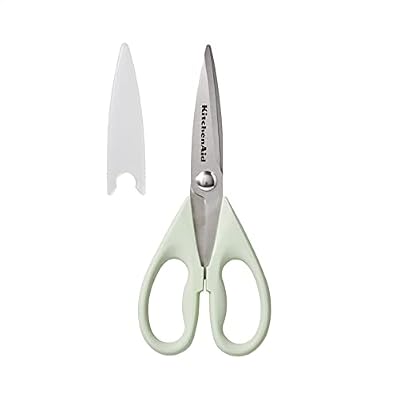
| KitchenAid All Purpose Kitchen Shears with Protective… | — | ★ 4.8 | 70.9k | $7.59 |
| KitchenAid All Purpose Kitchen Shears with Protective… | — | ★ 4.8 | 70.9k | $10.99 |
| KitchenAid All Purpose Kitchen Shears with Protective… | — | ★ 4.8 | 70.9k | $13.99 |
| Bostitch Office Premium 3 Hole Punch, 12 Sheet Capaci… | BostitchOfficeProducts | ★ 4.7 | 64.4k | $12.99 |
| 3M Littmann Classic III Monitoring Stethoscope, 5910C… | Littmann®Stethoscopes | ★ 4.8 | 50k | $112.16 |
Frequently Asked Questions
Can left-handers just use regular scissors?
They can, but the results are poor. Right-handed scissors push the blades apart for a lefty, producing ragged cuts and hiding the cutting line. For anything beyond rough cutting, left-handed scissors are far better.
What makes left-handed scissors different?
Two things: the blades are reversed so the left blade is on top, and the handles are contoured for the left hand. The blade reversal is the critical difference because it controls cut quality.
Are ambidextrous scissors as good as left-handed ones?
Not for precision work. Ambidextrous scissors usually have symmetrical handles but right-handed blade orientation, so lefties still get less clean cuts. They are a reasonable compromise only for casual, shared use.
How do I know if scissors are truly left-handed?
Hold them ready to cut and check which blade is on top. If the left blade is uppermost and the handles are shaped for the left hand, they are genuine. Testing on paper for a clean edge confirms it.
Do children need left-handed scissors?
Yes, if they are left-handed. Forcing a young lefty to use right-handed scissors leads to frustration and poor cutting, which can dent their confidence in craft activities.
Conclusion
The difference between left-handed and right-handed scissors is real and rooted in mechanics, not marketing. Reversed blades let lefties see the cutting line and squeeze the blades together for clean cuts, while contoured handles keep the hand comfortable. If you are left-handed and do any detailed cutting, a genuine left-handed pair transforms a daily frustration into a simple, satisfying task.
Related Reviews & Guides


Famous Left-Handed People and Surprising Facts

Why Are Left-Handers Rare? The Science Explained